

Vector Search Optimization: Introduction
Artificial intelligence has changed how people search for information online. Instead of matching only exact keywords, modern search engines understand the meaning behind a query. This shift has made Vector Search Optimization one of the most important strategies for businesses, marketers, and website owners who want to stay ahead in search results.
Whether someone uses Google AI Overviews, AI assistants, enterprise search, or chatbot-powered search engines, semantic understanding now plays a major role in delivering accurate answers. Businesses that optimize their content for vector-based retrieval can significantly improve visibility, user engagement, and organic traffic.
If your goal is to make your website future-ready, mastering Vector Search Optimization is no longer optional—it’s essential. At Wink Dezign, we help businesses prepare for the next generation of AI-powered search experiences through smart SEO strategies and technical optimization.
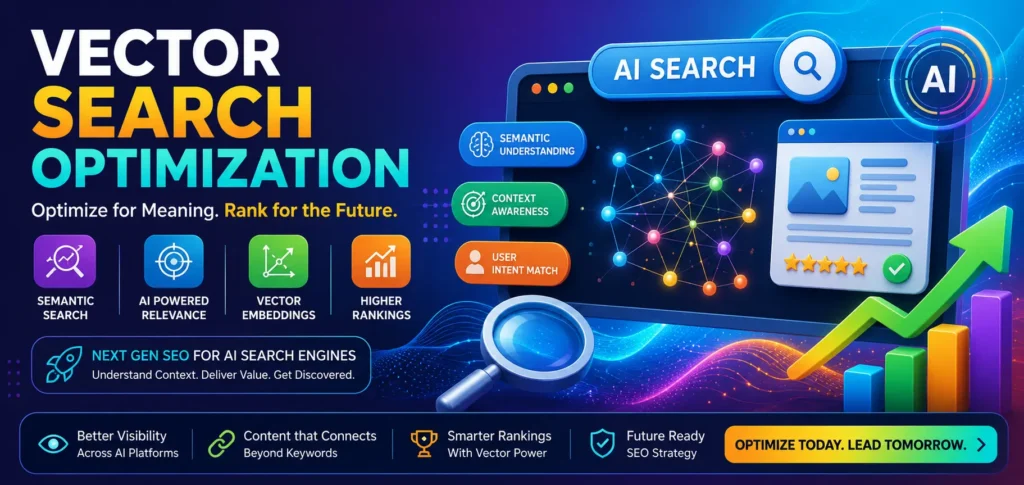
What is Vector Search Optimization?
Vector Search Optimization is the process of improving your website and content so AI-powered search engines can understand its meaning rather than relying only on exact keyword matches.
Traditional search engines compare keywords.
Vector search compares meaning, context, and semantic similarity.
Instead of asking:
“Best digital marketing company Chennai”
A user may search:
“Who can help my business get more online customers?”
Even though the wording is completely different, vector search understands both queries have similar intent.
This makes semantic optimization far more valuable than simply repeating keywords.
How Vector Search Works
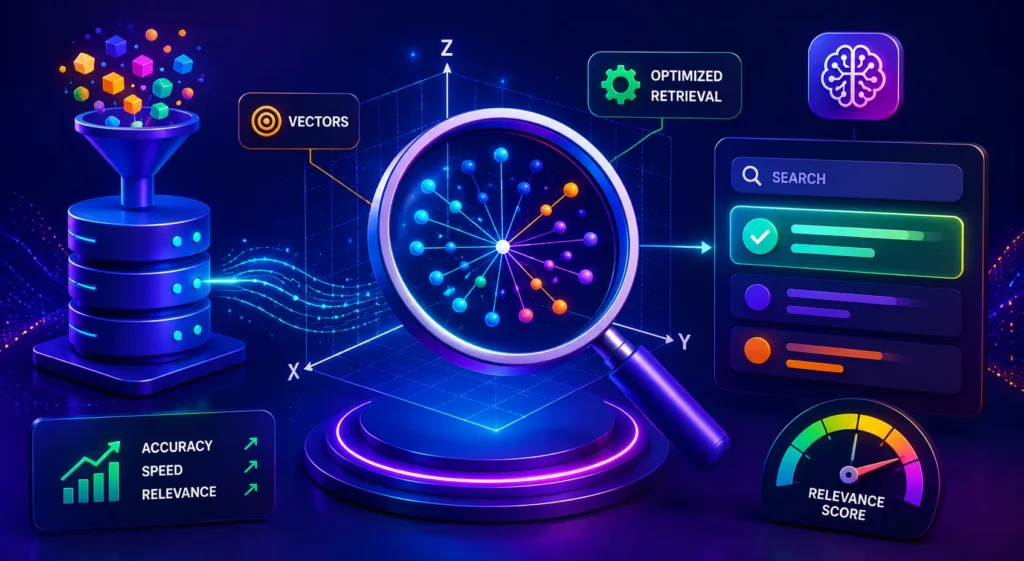
Modern AI search systems convert every document and every search query into mathematical representations called vectors.
These vectors capture relationships between words, topics, entities, and user intent.
The search engine then measures which content has the closest meaning to the user’s question.
The process usually follows these steps:
| Step | Process |
|---|---|
| User enters a query | AI understands intent |
| Query converted into vectors | Meaning is extracted |
| Database compares vector similarity | Semantic matching begins |
| Most relevant content retrieved | Best answer displayed |
| AI summarizes information | User receives contextual answer |
Unlike keyword search, vector search focuses on understanding language naturally.
Why Vector Search Optimization Matters
Search engines are evolving rapidly.
Google, Microsoft, OpenAI-powered search tools, and enterprise AI systems increasingly rely on semantic retrieval rather than keyword matching alone.
Benefits include:
- Better AI visibility
- Higher content relevance
- Improved search accuracy
- Better user satisfaction
- Increased organic traffic
- Higher engagement rates
- More qualified leads
Businesses investing in semantic optimization today will have a competitive advantage tomorrow.
Traditional Search vs Vector Search
Traditional Search | Vector Search |
|---|---|
| Matches keywords | Matches meaning |
| Exact phrase dependent | Context dependent |
| Limited understanding | Deep semantic understanding |
| Keyword stuffing once worked | Natural writing performs better |
| Ranking based on keywords | Ranking based on relevance |
| Less personalized | Highly personalized |
The shift is changing SEO forever.
How AI Uses Vector Search
Many AI platforms retrieve information before generating responses.
Instead of memorizing the entire internet, AI retrieves the most relevant documents using vector similarity.
Applications include:
- AI chatbots
- Customer support systems
- Enterprise knowledge bases
- Ecommerce product search
- Healthcare databases
- Legal document search
- Financial research
- Educational platforms
Whenever AI answers a complex question, vector retrieval often works behind the scenes.
Key Components of Vector Search Optimization
Successful Vector Search Optimization involves much more than inserting keywords into a webpage.
It combines technical SEO, content quality, semantic relationships, structured information, and user intent.
Important components include:
Semantic Content
Write naturally.
Cover related concepts instead of repeating one keyword.
For example, an article about vector search should also discuss:
- Semantic search
- Embeddings
- AI retrieval
- Contextual search
- Search intent
- Similarity matching
This helps AI understand topic depth.
Entity Optimization
Modern AI understands entities.
An entity is a person, company, place, product, or concept.
Instead of writing only:
Digital Marketing
Include entities like:
- Google Search
- OpenAI
- Microsoft Bing
- AI Search
- Large Language Models
These relationships improve semantic understanding.
Content Clustering
Instead of publishing isolated blogs, create related content.
Example:
Main Topic
Vector Search Optimization
Supporting Articles
- Semantic SEO
- AI Search Optimization
- GEO Optimization
- Search Embeddings
- Knowledge Graphs
- AI Content Strategy
Clusters build topical authority.
User Intent Optimization
Every search has intent.
Examples include:
Informational
“What is vector search?”
Commercial
“Best vector database”
Transactional
“Hire Vector Search SEO agency”
Your content should satisfy all relevant intents.
Benefits of Vector Search Optimization
Businesses adopting semantic SEO often experience measurable improvements.
Better Rankings
Content becomes more relevant for multiple related searches.
Instead of ranking for one keyword, one page may rank for hundreds of similar questions.
Improved User Experience
Visitors find answers faster.
This reduces bounce rate.
It also increases engagement.
Future-Proof SEO
Search continues moving toward AI understanding.
Optimizing today prepares your website for tomorrow’s algorithms.
Increased Organic Traffic
Because semantic search covers many query variations, your website can receive visitors from a much wider range of searches.
Example:
Instead of ranking only for:
“Vector Search Optimization”
You may also rank for:
- How vector search works
- AI semantic search
- Improve AI search visibility
- Semantic retrieval optimization
- AI search ranking factors
Real-World Example
Imagine two digital marketing agencies.
Agency A
Publishes:
“Vector Search Optimization” repeated 30 times.
Little explanation.
No examples.
No semantic context.
Agency B
Publishes:
- Comprehensive guides
- FAQs
- Practical examples
- AI search explanations
- Related semantic topics
- Internal linking
- Structured content
AI systems recognize Agency B as more authoritative because it provides greater topical depth and context.
As a result, Agency B is more likely to appear in AI-generated search responses and semantic search results.
Advanced Vector Search Optimization Strategies
Once you understand the fundamentals, the next step is implementing advanced techniques that help AI search engines recognize your content as authoritative, relevant, and trustworthy.
Build Comprehensive Topic Clusters
Rather than publishing isolated articles, organize your content into topic clusters.
For example, if your main pillar page is about Vector Search Optimization, supporting articles could include:
- Semantic SEO
- AI Search Optimization
- Generative Engine Optimization (GEO)
- Knowledge Graph Optimization
- Entity-Based SEO
- AI Content Optimization
- Embedding Models Explained
- Retrieval-Augmented Generation (RAG)
Link every supporting article back to the main pillar page and vice versa. This strengthens topical authority and helps AI systems understand the relationship between your content.
Optimize for Search Intent
Every piece of content should answer a specific user need.
Common search intents include:
Informational
Users want to learn.
Example:
- What is Vector Search Optimization?
- How does vector search work?
Commercial Investigation
Users compare options before making a decision.
Example:
- Best vector database
- Top AI SEO agencies
Transactional
Users are ready to take action.
Example:
- Hire a Vector Search Optimization company
- AI SEO services
Addressing multiple intents within a single comprehensive guide improves your chances of ranking for a wider range of searches.
Create Entity-Rich Content
AI search engines understand relationships between entities rather than relying only on keywords.
Mention relevant concepts naturally, such as:
- Semantic Search
- Machine Learning
- Large Language Models (LLMs)
- Natural Language Processing (NLP)
- Embeddings
- Vector Databases
- Search Intent
- Knowledge Graphs
Using related concepts helps search engines build a stronger understanding of your topic.
Use Structured Data
Schema markup makes your content easier for search engines to interpret.
Recommended schema types include:
- Article
- FAQ
- Organization
- Breadcrumb
- WebPage
- HowTo (where applicable)
Structured data can also improve your visibility in rich results and AI-generated summaries.
Technical SEO for Vector Search Optimization
Technical SEO remains a critical foundation.
Even exceptional content may struggle if technical issues prevent search engines from crawling or understanding your website.
Focus on:
- Fast page loading speed
- Mobile-friendly design
- HTTPS security
- Clean URL structure
- XML sitemap
- Robots.txt optimization
- Canonical tags
- Proper heading hierarchy
- Optimized Core Web Vitals
A technically healthy website allows AI systems to access and interpret your content efficiently.
Frequently Asked Questions (FAQs)
Conclusion
The future of search is moving beyond simple keyword matching. AI-powered search engines increasingly prioritize meaning, context, authority, and user satisfaction. Businesses that embrace Vector Search Optimization today will be better positioned to earn visibility, attract qualified visitors, and build long-term organic growth.
Success requires more than adding keywords to a page. It demands comprehensive content, strong technical SEO, semantic relevance, topical authority, and a genuine focus on helping users.
Whether you run a local business, an e-commerce store, or a growing enterprise, investing in Vector Search Optimization is a smart long-term strategy for staying competitive in the evolving search landscape.
If you’re looking for expert assistance with AI SEO, semantic optimization, technical SEO, or digital marketing strategies, Wink Dezign can help you build a future-ready online presence. Learn more at Winkdezign and discover how modern SEO techniques can help your business reach the right audience.
Start optimizing today and prepare your website for the next generation of AI-powered search.