


Retrieval-Augmented Content
Artificial Intelligence has transformed content marketing, but one major challenge remains—accuracy. Many AI-generated articles sound impressive but often contain outdated information, fabricated facts, or generic explanations.
This is where Retrieval-Augmented Content becomes a game changer.
Retrieval-Augmented Content combines artificial intelligence with real-time information retrieval, allowing AI to create content based on verified and relevant sources rather than relying only on pre-trained knowledge.
Businesses, marketers, SEO professionals, and website owners increasingly use Retrieval-Augmented Content to improve content quality, build trust, and meet Google’s EEAT guidelines.
Whether you manage a business website, an eCommerce platform, or a digital marketing agency like Winkdezign, understanding this approach can help you create content that ranks better while providing genuine value to readers.
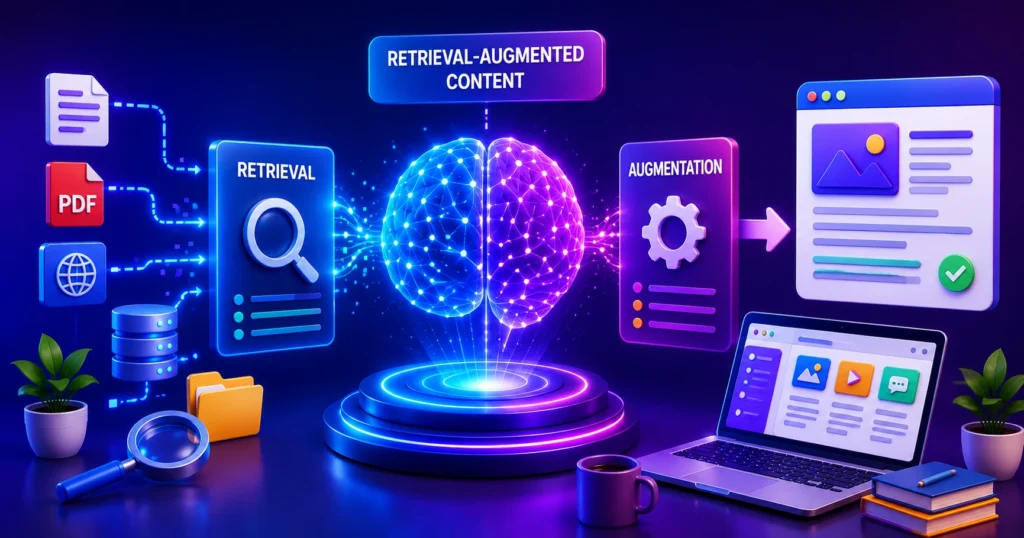
What is Retrieval-Augmented Content?
Retrieval-Augmented Content is an AI-assisted content creation method where an AI system first retrieves relevant information from trusted sources before generating the final content.
Instead of guessing or relying only on its internal knowledge, the AI searches approved databases, documentation, research papers, websites, or business knowledge repositories.
The result is:
- Higher factual accuracy
- Better context
- Updated information
- Reduced AI hallucinations
- Improved user trust
Think of it as an intelligent research assistant working alongside an expert writer.
How Retrieval-Augmented Content Works
The workflow is straightforward.
| Step | Process |
|---|---|
| 1 | User asks a question |
| 2 | AI searches trusted information |
| 3 | Relevant data is retrieved |
| 4 | AI understands the retrieved information |
| 5 | AI creates natural, readable content |
Unlike traditional AI writing, Retrieval-Augmented Content focuses on evidence before generation.
Why Retrieval-Augmented Content Matters for SEO
Google increasingly rewards content that demonstrates:
- Experience
- Expertise
- Authority
- Trustworthiness
Generic AI content often lacks these qualities.
Retrieval-Augmented Content helps solve this problem by grounding content in reliable information.
Benefits include:
- Better content quality
- Improved topical authority
- Lower misinformation
- Better user engagement
- Higher credibility
- More comprehensive answers
When readers trust your content, search engines notice positive engagement signals.
Key Components of Retrieval-Augmented Content
Information Retrieval
The AI first searches reliable databases or indexed documents.
Examples include:
- Company documentation
- Product manuals
- Research databases
- Government resources
- Knowledge bases
Context Understanding
The retrieved information is analyzed.
The AI determines:
- Which information is relevant
- Which facts are recent
- Which details answer the user’s question
Natural Language Generation
Instead of copying sources, the AI rewrites information naturally while maintaining accuracy.
The final content reads like it was written by a human expert.
Benefits of Retrieval-Augmented Content
1. Better Accuracy
One of the biggest advantages is factual correctness.
Instead of inventing answers, AI references trusted information before writing.
2. Updated Information
Technology changes quickly.
SEO algorithms evolve.
Product specifications change.
Retrieval-Augmented Content keeps information more current.
3. Improved EEAT
Google values expertise and trustworthy content.
When AI uses authoritative information, content naturally aligns better with EEAT principles.
4. Higher User Trust
Readers can quickly identify low-quality AI content.
Well-researched articles improve credibility.
People stay longer and are more likely to share useful resources.
5. Better Search Rankings
Although Google doesn’t rank pages simply because they use AI, it rewards:
- Helpful content
- Accurate information
- Comprehensive answers
- User satisfaction
Retrieval-Augmented Content supports all these ranking factors.

Best Practices for Retrieval-Augmented Content
Use Trusted Sources
Only retrieve information from:
- Government websites
- Industry associations
- Official documentation
- Research papers
- Company knowledge bases
Keep Databases Updated
Outdated databases create outdated content.
Schedule regular updates.
Add Human Expertise
AI should assist—not replace—human expertise.
Editors should:
- Verify facts
- Improve readability
- Add experience
- Include examples
Focus on User Intent
Always answer the reader’s question first.
Don’t overload articles with unnecessary keywords.
Include Original Insights
Add:
- Personal experience
- Expert commentary
- Business observations
- Case studies
- Practical recommendations
These improve EEAT significantly.
Common Mistakes to Avoid
Avoid these errors:
- Blindly trusting AI output
- Using outdated databases
- Ignoring source quality
- Keyword stuffing
- Publishing without editing
- Missing citations where appropriate
Human review remains essential.
How Retrieval-Augmented Content Improves User Experience
Visitors appreciate content that:
- Answers questions quickly
- Provides accurate details
- Uses clear language
- Includes examples
- Avoids misinformation
Satisfied users spend more time reading.
This often improves important engagement metrics.
Future of Retrieval-Augmented Content
As AI continues evolving, retrieval-based systems are becoming standard.
Future improvements may include:
- Real-time indexing
- Better personalization
- Industry-specific knowledge retrieval
- Multimodal information retrieval
- Voice-enabled retrieval
- Enterprise AI assistants
Businesses adopting Retrieval-Augmented Content today will likely gain a competitive advantage.
Best SEO Practices for Retrieval-Augmented Content
For maximum SEO performance:
- Write compelling titles.
- Optimize headings.
- Add schema markup.
- Include internal links.
- Use descriptive image alt text.
- Update articles regularly.
- Improve page speed.
- Focus on search intent.
- Build topical authority.
- Monitor user engagement metrics.
Frequently Asked Questions (FAQs)
Conclusion
Retrieval-Augmented Content is reshaping how businesses create high-quality digital content. By combining artificial intelligence with trusted information retrieval, organizations can publish articles that are more accurate, informative, and aligned with Google’s EEAT principles.
Instead of producing generic AI-generated text, Retrieval-Augmented Content enables businesses to deliver meaningful answers, practical insights, and trustworthy information that users genuinely value. This approach not only strengthens search visibility but also improves reader confidence, engagement, and long-term brand authority.
Whether you’re a startup, an enterprise, or a digital marketing agency, adopting Retrieval-Augmented Content can help future-proof your SEO strategy. Pairing AI with human expertise ensures your content remains relevant, credible, and competitive in an evolving search landscape.
If you’re looking to build SEO-focused, AI-enhanced, and user-first content strategies, explore the digital marketing and content development solutions offered by Winkdezign to create content that performs for both search engines and your audience.