


LLM Optimization (LLMO): The Complete Guide to Ranking in AI Search
Artificial Intelligence is changing how people search for information online. Instead of clicking through several websites, users now ask AI assistants direct questions and receive detailed answers within seconds.
This shift has created a new optimization strategy known as LLM Optimization (LLMO). Businesses that understand LLM Optimization (LLMO) can improve their visibility not only in traditional search engines but also in AI-powered platforms like ChatGPT, Google AI Overviews, Microsoft Copilot, Gemini, Claude, and Perplexity.
If your business still focuses only on traditional SEO, you’re missing a growing source of traffic. Modern brands need content that is understandable to both search engines and Large Language Models (LLMs).
In this guide, you’ll learn everything about LLM Optimization (LLMO), why it matters, how it differs from SEO, practical implementation strategies, common mistakes, and proven best practices to future-proof your website.
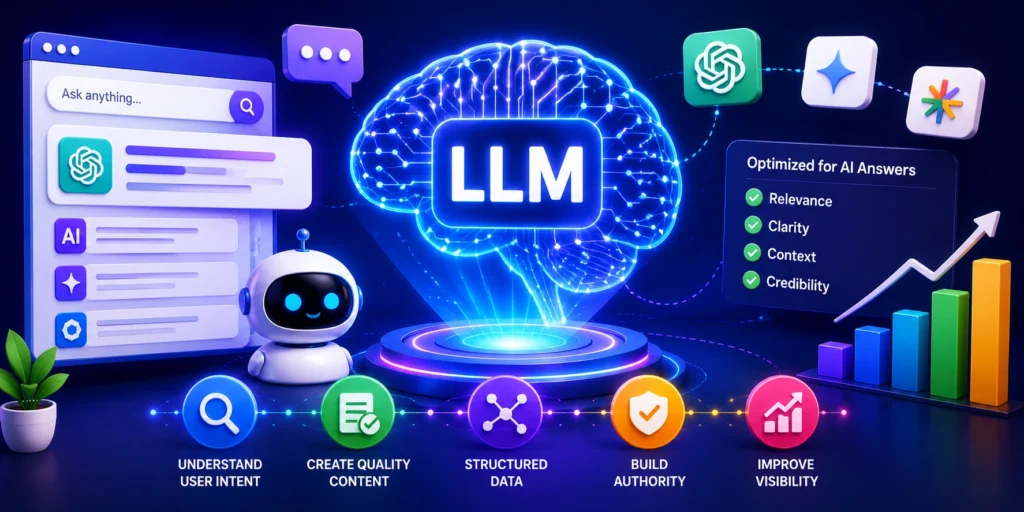
What is LLM Optimization (LLMO)?
LLM Optimization (LLMO) is the process of creating, structuring, and publishing content that can be easily understood, trusted, and referenced by Large Language Models (LLMs).
Unlike traditional SEO, where the goal is ranking on search engine result pages, LLMO focuses on making your content valuable enough for AI assistants to cite, summarize, or recommend in their responses.
Simply put,
SEO helps people find your website.
LLM Optimization (LLMO) helps AI systems understand and recommend your content.
As AI-powered search becomes more popular, businesses that optimize for LLMs gain a significant competitive advantage.
Why LLM Optimization (LLMO) Matters
Consumer behavior has changed dramatically.
Instead of typing:
“Best digital marketing agency”
Users now ask:
“Which digital marketing agency offers SEO, website development, and AI marketing services for small businesses?”
AI generates a complete answer instantly.
If your website contains well-structured, trustworthy information, AI is more likely to reference your brand.
Benefits include:
- Increased AI search visibility
- Higher brand authority
- Better organic traffic
- Improved user trust
- More qualified leads
- Stronger topical authority
- Better content discoverability
- Future-proof digital marketing
Businesses investing in LLM Optimization (LLMO) today are preparing for tomorrow’s search landscape.
How Large Language Models Understand Content
Large Language Models don’t browse websites like humans.
Instead, they analyze:
- Context
- Entity relationships
- Semantic meaning
- Structured information
- Topic relevance
- Content quality
- Trustworthiness
- Author expertise
For example, consider two articles.
Article A simply repeats the keyword many times.
Article B explains the topic clearly, includes examples, definitions, FAQs, structured headings, expert insights, and trustworthy references.
An AI assistant will almost always prefer Article B.
That’s exactly where LLM Optimization (LLMO) becomes valuable.
How LLM Optimization (LLMO) Differs from Traditional SEO
| Traditional SEO | LLM Optimization (LLMO) |
|---|---|
| Targets Google rankings | Targets AI understanding |
| Focuses on keywords | Focuses on context |
| Optimizes backlinks | Optimizes entities and trust |
| Search engine bots | AI language models |
| SERP rankings | AI citations |
| Meta tags | Structured knowledge |
| Page authority | Information authority |
| Click optimization | Answer optimization |
Traditional SEO remains important.
However, LLM Optimization (LLMO) expands beyond rankings and focuses on becoming the most reliable source of information.
Core Pillars of LLM Optimization (LLMO)
1. High-Quality Content
AI systems prioritize content that demonstrates expertise.
Your articles should:
- Answer real user questions
- Explain concepts clearly
- Include examples
- Stay updated
- Avoid fluff
Instead of writing for algorithms, write for people.
Quality naturally improves AI understanding.
2. Semantic Relevance
Semantic SEO plays a major role in LLM Optimization (LLMO).
Rather than repeating the same keyword, naturally include related terms like:
- AI Search Optimization
- Generative Engine Optimization
- Large Language Models
- AI Search
- Entity SEO
- Semantic Search
- Knowledge Graph
- AI Content Discovery
- Structured Data
- Conversational Search
These related concepts help AI understand the broader topic.
3. Entity-Based Optimization
Modern AI identifies entities rather than isolated keywords.
Examples include:
- Companies
- Products
- Services
- People
- Locations
- Technologies
Instead of saying:
“We offer digital services.”
Write:
“Wink Dezign provides website development, SEO, branding, eCommerce solutions, AI-powered digital marketing, and performance marketing services.”
This provides richer context for AI systems.
4. Experience Signals
Google’s EEAT framework aligns closely with LLM Optimization (LLMO).
Demonstrate:
- Real experience
- Original insights
- Case studies
- Client examples
- Industry expertise
- Transparent information
The more authentic your content appears, the more trustworthy it becomes.
5. Structured Content
AI prefers organized information.
Use:
- Clear headings
- Bullet lists
- Numbered steps
- Comparison tables
- FAQs
- Definitions
- Summaries
Well-structured pages are easier for both humans and AI to process.
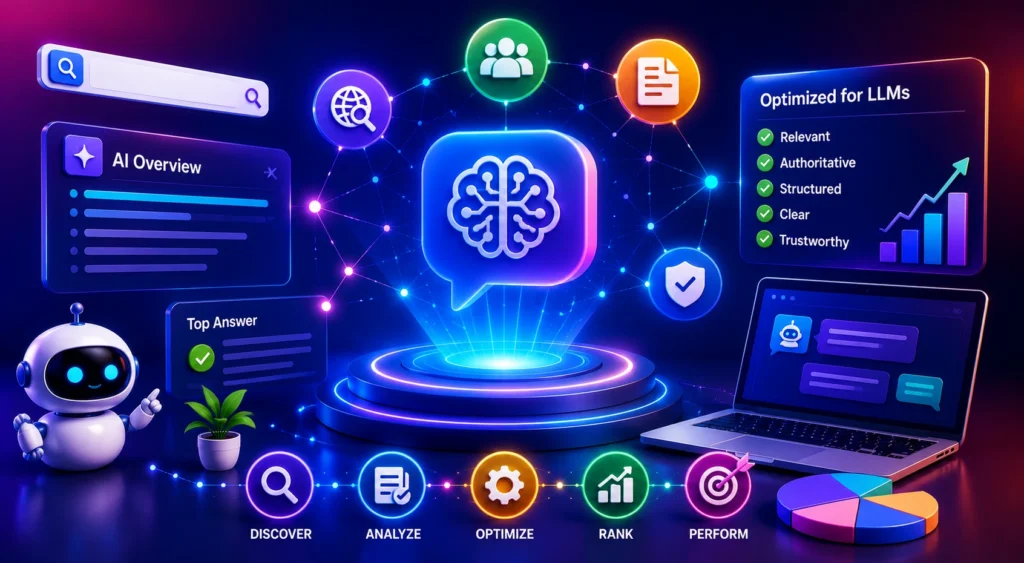
Essential Elements of an LLM-Optimized Article
Every article should include:
- A clear introduction
- Simple definitions
- Practical examples
- FAQs
- Lists
- Tables
- Statistics
- Expert opinions
- Actionable tips
- Updated information
- Internal links
- External references
Avoid overly promotional language.
Instead, focus on educating readers.
Best Practices for LLM Optimization (LLMO)
Write for Questions
People increasingly interact with AI using conversational questions.
Instead of optimizing only for:
“Digital marketing”
Also answer:
- What is digital marketing?
- How does digital marketing work?
- Why is digital marketing important?
- Which businesses need digital marketing?
- What are the benefits?
Question-based content aligns naturally with AI search behavior.
Create Topic Clusters
Don’t publish isolated articles.
Instead, build interconnected content around one subject.
Example:
Main Topic:
LLM Optimization (LLMO)
Supporting Articles:
- AI SEO Guide
- Entity SEO
- Semantic SEO
- AI Search Optimization
- Google AI Overviews
- Structured Data Guide
- Content Authority
- Knowledge Graph SEO
This strengthens topical authority.
Add Original Examples
AI values unique insights.
Instead of generic advice, include original scenarios.
Mini Case Scenario
A local web design company published a comprehensive guide explaining AI search optimization.
The article included FAQs, expert insights, comparison tables, and practical examples.
Within a few months, the content began receiving increased organic visibility because it answered real user intent comprehensively.
This illustrates how quality content can outperform thin pages.
Keep Content Updated
AI systems favor current, accurate information.
Review important articles regularly.
Update:
- Statistics
- Screenshots
- Tools
- Best practices
- Industry trends
Fresh content builds long-term credibility.
Improve Readability
Simple writing performs better.
Use:
- Short sentences
- Short paragraphs
- Active voice
- Clear examples
- Everyday language
Avoid unnecessary technical jargon unless you explain it.
Common Mistakes to Avoid in LLM Optimization (LLMO)
Many businesses unknowingly reduce their AI visibility by making avoidable mistakes.
Here are some of the most common ones:
- Stuffing the focus keyword unnaturally.
- Publishing thin or duplicate content.
- Ignoring semantic keywords.
- Writing only for search engines instead of people.
- Skipping structured headings and FAQs.
- Failing to demonstrate real expertise or experience.
- Using outdated information without regular updates.
- Creating isolated articles instead of building topical authority.
- Neglecting internal linking between related pages.
- Overusing AI-generated content without human review or original insights.
Avoiding these issues can significantly improve the chances of your content being understood and trusted by AI-powered search systems.
Advanced Strategies for LLM Optimization (LLMO)
Once you have covered the fundamentals, the next step is to build content that AI systems recognize as a reliable knowledge source. Advanced LLM Optimization (LLMO) focuses on authority, context, and content relationships rather than keywords alone.
Build Topical Authority
Publishing a single article is no longer enough.
AI models evaluate whether your website consistently covers a topic in depth.
For example, if your business provides digital marketing services, create supporting articles about:
- Search Engine Optimization (SEO)
- Entity SEO
- Technical SEO
- AI Search Optimization
- Content Marketing
- Local SEO
- Voice Search Optimization
- Google AI Overviews
- Schema Markup
- Website Performance
A collection of interconnected articles signals expertise and improves your authority.
Use Clear Entity Relationships
Large Language Models understand entities and how they relate to each other.
Instead of mentioning services randomly, explain the relationship between them.
Example:
A website redesign improves user experience.
Better user experience increases engagement.
Higher engagement supports SEO performance.
Strong SEO increases visibility in AI search.
This logical flow helps AI understand the complete picture.
Answer Search Intent Completely
Every article should answer multiple user questions.
Instead of writing only about “What is LLM Optimization (LLMO)?”
Also answer:
- Why is it important?
- Who needs it?
- How does it work?
- What tools can help?
- What mistakes should be avoided?
- How can businesses implement it?
Comprehensive content is more likely to be referenced by AI assistants.

Technical Optimization for LLM Optimization (LLMO)
Technical SEO continues to play an important role.
AI systems prefer websites that are easy to crawl and understand.
Consider these technical best practices:
- Use HTTPS for secure browsing.
- Improve Core Web Vitals.
- Optimize page loading speed.
- Create XML sitemaps.
- Maintain a clean URL structure.
- Fix broken links.
- Ensure mobile responsiveness.
- Add descriptive image alt text.
- Implement structured data where relevant.
- Keep navigation simple and logical.
A technically sound website provides a better experience for users and AI systems alike.
Frequently Asked Questions (FAQs)
Conclusion
Traditional SEO remains essential, but it is no longer enough on its own.
Businesses that embrace LLM Optimization (LLMO) create content that is informative, trustworthy, well-structured, and genuinely useful. This approach improves visibility across both traditional search engines and AI-powered search platforms.
Rather than chasing algorithms, focus on answering real questions, demonstrating expertise, and building topical authority. Over time, this strategy helps establish your brand as a reliable source of information that users and AI systems can trust.
Whether you are a startup, a growing business, or an established enterprise, investing in LLM Optimization (LLMO) today will help you stay competitive in the future of search.
Call to Action
Ready to prepare your business for the future of AI-powered search?
Wink Dezign helps businesses build SEO-friendly, AI-ready websites and content strategies that improve online visibility, strengthen authority, and drive sustainable growth.
Visit Winkdezign to explore our SEO, web design, digital marketing, and AI optimization services. Let us help you create content that performs well for both people and intelligent search systems.