


GEO Full Form in Digital Marketing: What It Means and Why It Matters in 2026
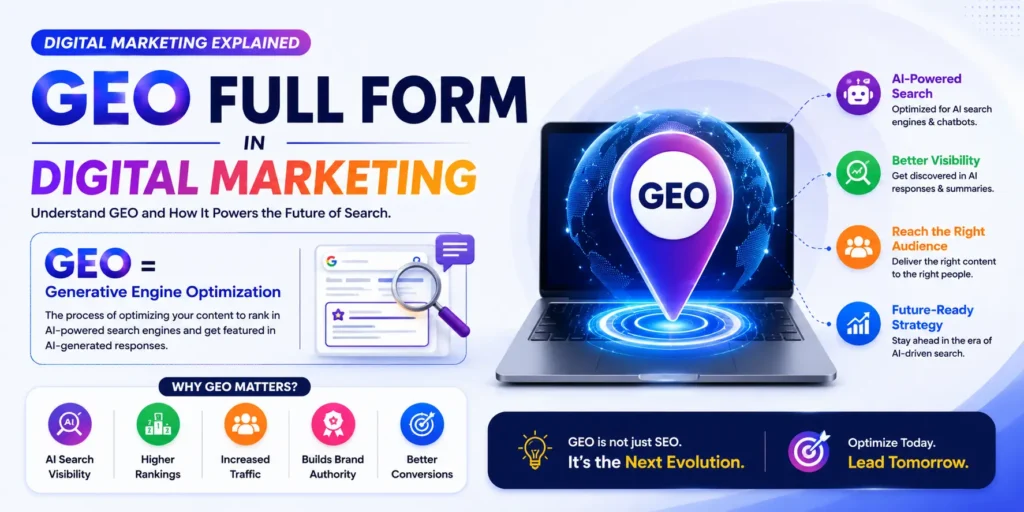
If you’ve been searching for the GEO full form in digital marketing, the answer is straightforward: GEO stands for Generative Engine Optimization — the practice of optimizing content so it gets accurately surfaced, cited, or recommended by AI-powered search tools like Google’s AI Overviews, ChatGPT, Perplexity, and similar generative engines. Understanding the GEO full form in digital marketing is quickly becoming essential knowledge for businesses and marketers, since AI-generated answers are increasingly replacing traditional blue-link search results for many queries.
This guide breaks down exactly what GEO means, how it differs from traditional SEO, why it’s become important in 2026, practical ways to optimize for it, and answers to the most common questions marketers have about this emerging discipline.
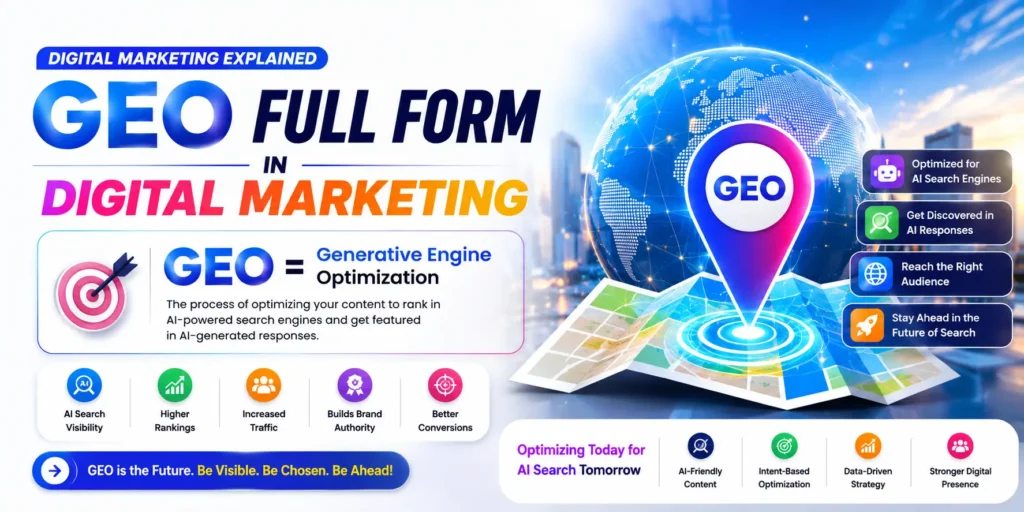
GEO Full Form in Digital Marketing: The Complete Breakdown
G — Generative
E — Engine
O — Optimization
Put together, the GEO full form in digital marketing refers to Generative Engine Optimization: the strategic process of structuring, writing, and formatting content so that AI systems can easily understand, extract, and accurately represent it when generating responses to user queries.
Unlike traditional search engines that return a list of ranked links, generative engines synthesize information from multiple sources into a single, conversational answer — often without the user ever clicking through to the original website. This fundamental shift is exactly why understanding the GEO full form in digital marketing has become so important for businesses that want to remain visible as search behavior evolves.
GEO vs. SEO: What's the Actual Difference?
| Factor | Traditional SEO | GEO (Generative Engine Optimization) |
|---|---|---|
| Goal | Rank in a list of search results | Get cited or referenced in an AI-generated answer |
| Success metric | Click-through rate, ranking position | Inclusion and accuracy in AI responses |
| Content structure | Keyword-optimized pages | Clear, factual, well-structured, easily extractable content |
| User outcome | User clicks to visit your site | User may get their answer without visiting your site |
| Trust signals | Backlinks, domain authority | E-E-A-T, factual accuracy, structured data |
While the GEO full form in digital marketing represents a distinct discipline, it doesn’t replace traditional SEO — the two work together, since AI systems still rely heavily on well-indexed, authoritative web content as their source material.
Why Understanding the GEO Full Form in Digital Marketing Matters Now
Search behavior has changed significantly as AI-powered tools have become mainstream. Google’s AI Overviews now appear for a substantial share of search queries, often answering the user’s question directly at the top of the results page. Similarly, tools like ChatGPT, Perplexity, and Claude are increasingly used as primary research and discovery tools, particularly for local business recommendations and product research.
This shift means that even if your website ranks well in traditional search, your content might never be seen if an AI system generates an answer without citing your page as a source. Grasping the GEO full form in digital marketing — and actively optimizing for it — helps ensure your business stays visible in this new search landscape, not just the old one.
How Generative Engines Actually Work
Understanding the mechanics behind the GEO full form in digital marketing helps clarify why certain optimization strategies matter:
- Crawling and indexing — AI systems, like traditional search engines, still need to discover and process web content, meaning basic technical SEO remains foundational.
- Content extraction — Generative engines identify specific facts, definitions, or answers within a page rather than evaluating the page as a whole.
- Synthesis — The AI combines information from multiple sources to construct a coherent, conversational response.
- Citation (sometimes) — Depending on the platform, the AI may or may not explicitly cite or link to the original source.
Because of this process, content written specifically with GEO principles in mind — clear structure, direct answers, and factual precision — has a significantly better chance of being accurately extracted and represented.
Practical Ways to Optimize for GEO
Write Clear, Direct Answers Early
Structuring content so that direct, concise answers appear early in a section — rather than buried under lengthy introductions — makes it easier for AI systems to extract accurate information.
Use Structured Data and Schema Markup
FAQ schema, HowTo schema, and other structured data formats help AI systems understand exactly what a page is answering, improving the likelihood of accurate representation.
Prioritize E-E-A-T Signals
Since generative engines aim to synthesize trustworthy information, content demonstrating genuine Experience, Expertise, Authoritativeness, and Trustworthiness is more likely to be selected as a reliable source.
Break Content Into Clear, Scannable Sections
Well-organized headers, bullet points, and tables — similar to this article’s structure — make it significantly easier for AI systems to parse and extract specific pieces of information accurately.
Maintain Factual Accuracy and Consistency
Since AI systems often cross-reference multiple sources, consistent, accurate information across your website and other platforms increases the likelihood of being cited correctly rather than misrepresented.
Answer Questions Directly
Content structured around genuine questions — much like an FAQ format — aligns naturally with how users phrase queries to AI assistants, improving the chances of accurate matching.
Common Misconceptions About GEO
- “GEO replaces SEO.” In reality, strong technical and on-page SEO remains foundational — GEO builds on top of solid SEO practices rather than replacing them.
- “GEO is only for AI chatbots.” GEO principles also apply to Google’s AI Overviews and other AI-integrated search features embedded directly within traditional search engines.
- “There’s a guaranteed way to get cited by AI.” No optimization technique guarantees inclusion in every AI-generated response, since generative engines use complex, evolving selection criteria.
- “Small businesses don’t need to worry about GEO.” Local businesses are increasingly affected, since AI tools are commonly used for local recommendations and comparisons.
Why Winkdezign Incorporates GEO Into Content Strategy
Winkdezign, a Madurai-based digital marketing agency with an additional presence in Chennai, has begun integrating generative engine optimization principles into its content marketing and SEO services — recognizing that businesses need visibility across both traditional search results and AI-generated answers.
Rather than treating GEO as a separate, isolated service, Winkdezign builds content following clear structure, factual accuracy, and E-E-A-T principles from the start — ensuring client content is well-positioned for both conventional SEO rankings and AI-generated search summaries.
How GEO Is Evolving as a Discipline in 2026
Growing platform diversity. As AI search tools multiply — each with different citation behaviors and content preferences — optimizing content that performs well across multiple generative engines has become increasingly important.
Structured data emphasis. Schema markup continues gaining importance as a direct signal helping AI systems accurately parse and categorize web content.
Measurement challenges persist. Unlike traditional SEO metrics, tracking exactly when and how often content gets cited within AI-generated responses remains technically challenging, with tools and standards still evolving.
Increased scrutiny on AI-generated content. As search engines and generative platforms alike prioritize genuine expertise, content that reads as generic or AI-generated without real substance increasingly struggles to gain visibility in either traditional or AI-driven search.
Frequently Asked Questions
What is the GEO full form in digital marketing?
+GEO stands for Generative Engine Optimization — the practice of optimizing content to be accurately surfaced, cited, or referenced by AI-powered search tools and generative engines.
Is GEO the same as SEO?
+No — while related, SEO focuses on ranking in traditional search results, while GEO focuses on getting content accurately represented within AI-generated answers, though the two disciplines work together.
Do I need to abandon traditional SEO to focus on GEO?
+No — strong technical and on-page SEO remains foundational, since generative engines still rely on well-indexed, authoritative web content as their source material.
How can I tell if my content is being cited by AI tools?
+Tracking AI citations is still an evolving practice, though some emerging tools and platforms are beginning to offer visibility into how often content appears within AI-generated responses.
Does GEO matter for small, local businesses?
+Yes — as AI tools become common for local recommendations and comparisons, small businesses benefit from ensuring their content is structured clearly enough to be accurately represented by generative engines.
Conclusion
Understanding the GEO full form in digital marketing — Generative Engine Optimization — is increasingly essential as AI-powered search tools reshape how people discover information and businesses online. While GEO builds on the same foundation as traditional SEO, it requires deliberate attention to content structure, factual accuracy, and clear, extractable answers.
Winkdezign incorporates GEO principles alongside traditional SEO and content marketing strategy, helping businesses stay visible across both conventional search results and emerging AI-generated answers.
Ready to make sure your business stays visible in the age of AI search? Book a free consultation with Winkdezign today.