


Introduction: Why SEO Services for Small Businesses Matter
In today’s digital marketplace, having a website is not enough to attract customers. Your potential customers are searching on Google for products, services, and businesses that can solve their problems. If your website does not appear when they search for relevant keywords, you may miss valuable business opportunities.
SEO Services for Small Businesses help improve your website’s visibility in search engines, attract relevant visitors, and build a stronger online presence. Whether you operate a local shop, service company, startup, or online store, a well-planned SEO strategy can support your business growth.
Unlike paid advertising, search engine optimization focuses on improving your website’s organic visibility. Results depend on competition, website quality, search intent, and other factors. SEO does not guarantee a particular ranking or a specific number of leads.
This guide explains how small businesses can use SEO, what services are involved, how to select an SEO partner, and how to measure performance.
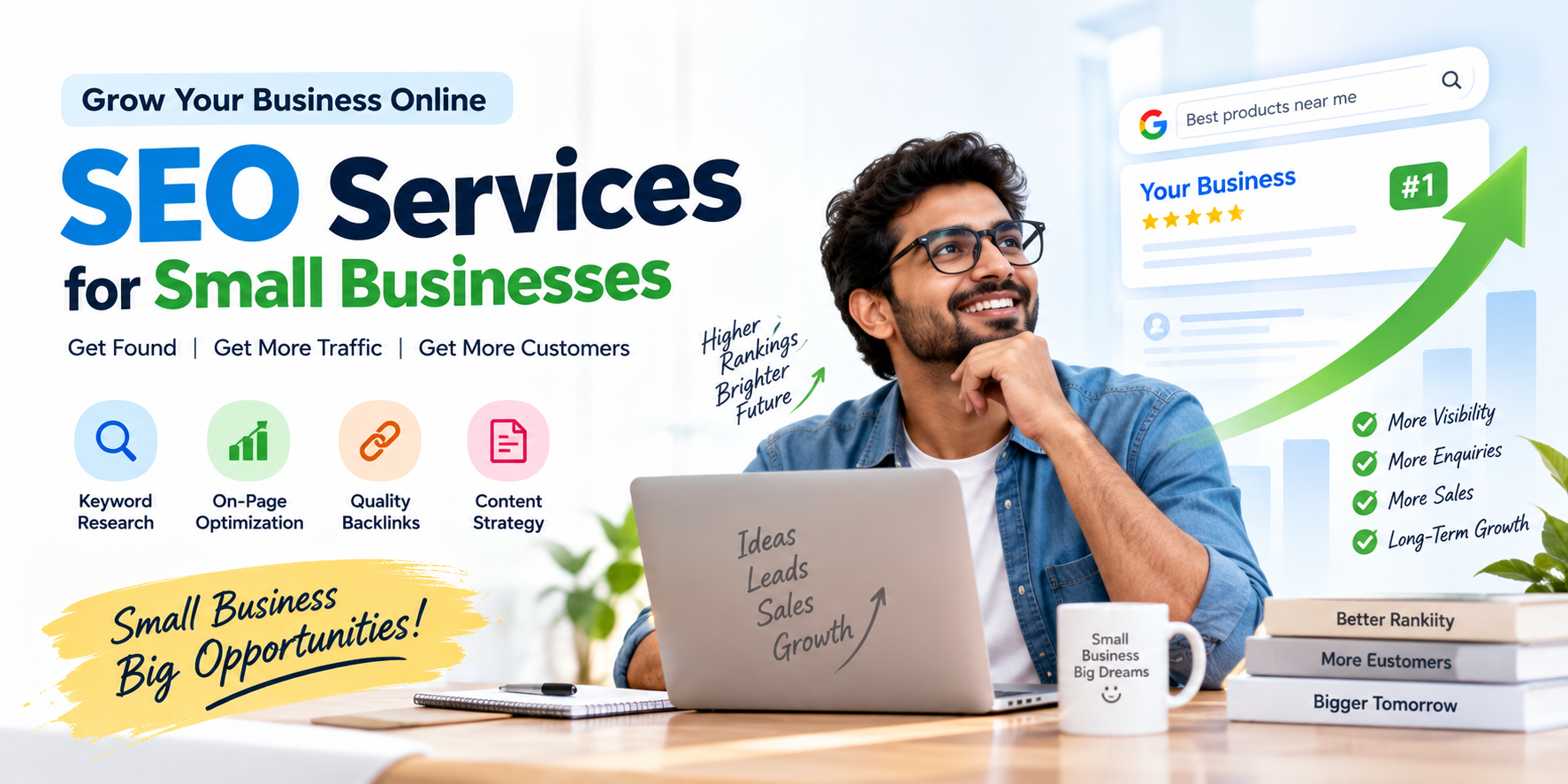
What Are SEO Services for Small Businesses?
SEO Services for Small Businesses are professional strategies and activities designed to improve a small company’s visibility in organic search results.
These services typically include:
- Keyword research
- Website SEO audits
- On-page optimization
- Technical SEO
- Local SEO
- Content development
- Link building
- Performance tracking
- Conversion optimization
- Search visibility improvement
The exact services required depend on the business industry, location, competition, website condition, and marketing goals.
For example, a local construction company may focus on searches such as construction contractors near me, while an online clothing store may target product-related keywords.
An SEO campaign should connect search visibility with business objectives rather than focusing only on rankings.
How SEO Works for a Small Business
The general SEO process involves:
Search Query → Search Engine Discovery → Relevant Website Content → Website Visit → Customer Enquiry or Purchase
Search engines crawl and index websites before displaying relevant pages for search queries. Businesses can improve how their websites are understood by creating useful content, maintaining accessible website structures, and following search engine guidelines.
Google recommends creating helpful, reliable, people-first content and using relevant descriptive terms in prominent locations, such as page titles and headings.
Why Do Small Businesses Need SEO?
Small businesses often compete with established companies that have larger marketing budgets. SEO provides an opportunity to build visibility through useful content, relevant search targeting, and a technically sound website.
1. Improve Online Visibility
When people search for services related to your business, appearing in relevant organic results can help them discover your company.
For instance, a digital marketing agency may target searches such as:
- Digital marketing agency in Madurai
- SEO services for small businesses
- Website development services
- Social media marketing agency
Your website’s appearance depends on multiple factors, including relevance, content quality, technical accessibility, and competition.
2. Attract Relevant Website Visitors
Not every website visitor is a potential customer. Effective keyword research identifies the queries that align with your products and services.
For example:
| Search Keyword | Potential User Intent |
|---|---|
| SEO services for small businesses | Looking for an SEO provider |
| Affordable SEO packages | Comparing service costs |
| Local SEO services | Seeking local search optimization |
| SEO agency near me | Looking for nearby providers |
| How does SEO work? | Researching SEO concepts |
Targeting relevant search intent helps businesses create content that addresses what potential customers need.
3. Support Long-Term Marketing
Paid advertising can generate visibility while campaigns are active. SEO focuses on improving the website’s organic search presence over time.
However, SEO requires ongoing maintenance. Search trends, competitors, business offerings, and search engine systems can change. There is no universal timeline for results.
Google explains that changes to a website may take anywhere from hours to several months to be reflected in search results, and not every change produces a noticeable impact.
4. Build Business Credibility
A professional website with clear service information, customer reviews, useful content, and transparent business details can help visitors evaluate a company.
SEO itself does not automatically establish trust. Businesses should support their claims with accurate information, authentic experiences, and clear contact details.
Key SEO Services for Small Businesses
A successful SEO strategy generally combines several complementary activities. The following services can be adapted according to your business requirements.
1. Keyword Research and Search Intent Analysis
Keyword research is the foundation of effective SEO planning. It helps identify the terms potential customers use when searching for products and services.
An SEO professional studies:
- Search relevance
- Keyword competition
- Search intent
- Location-based queries
- Commercial keywords
- Informational searches
- Long-tail keywords
- Seasonal search trends
Example: Keyword Strategy for a Local Business
Imagine a small interior design company operating in Chennai.
Instead of targeting only the broad keyword interior design, the company may explore more specific queries:
- Interior designers in Chennai
- 2BHK interior designers in Chennai
- Modular kitchen designers near me
- Affordable home interior design
- Modern bedroom interior design ideas
Each keyword may represent a different stage of the customer’s decision-making process.
Practical Tip: Choose keywords based on the services you genuinely provide. Avoid creating pages for unrelated keywords simply to increase website traffic.
2. On-Page SEO Optimization
On-page SEO improves the content and structure of individual website pages.
This is an important component of SEO Services for Small Businesses because small companies often have opportunities to improve existing service pages, product descriptions, and website content.
3. Technical SEO Services
Technical SEO focuses on the technical aspects of a website that affect crawling, indexing, and usability.
Even valuable content may face visibility challenges if search engines cannot access or understand important pages.
Core Technical SEO Activities
Website Crawling and Indexing
Check whether important pages can be discovered and indexed.
Mobile Usability
Ensure that the website works effectively across mobile devices and screen sizes.
Website Performance
Review loading performance and address technical issues affecting user experience.
HTTPS Security
Use HTTPS to protect website connections.
XML Sitemap
Maintain an appropriate sitemap to help search engines discover relevant URLs.
Canonicalization
Use canonical signals where appropriate to manage duplicate or similar URLs.
Broken Links
Identify and fix broken internal links that affect navigation.
Structured Data
Implement relevant structured data when it accurately describes page content and meets search engine guidelines.
Why Technical SEO Matters
Consider an e-commerce website with hundreds of product pages. If important product URLs are blocked from crawling or poorly linked, search engines may have difficulty discovering them.
Technical SEO helps establish a stronger foundation for content and search visibility.
Google’s Search Essentials cover technical requirements, spam policies, and practices that can help websites appear in Google Search.
4. Local SEO for Small Businesses
Local SEO is particularly relevant to businesses that serve customers in a specific geographic area.
Examples include:
- Restaurants
- Clinics
- Construction companies
- Salons
- Digital marketing agencies
- Retail shops
- Educational institutions
- Home service providers
Local SEO helps businesses manage their online presence and make relevant information easier for potential customers to find.
Google Business Profile Optimization
A Google Business Profile can provide information such as:
- Business name
- Address
- Phone number
- Business hours
- Website
- Services
- Photos
- Customer reviews
Businesses should maintain accurate information and follow Google’s policies.
Local SEO Best Practices
- Keep business information accurate.
- Use consistent contact details across relevant platforms.
- Create location-specific service pages where useful.
- Encourage genuine customer reviews.
- Respond professionally to customer feedback.
- Publish helpful, relevant local content.
- Maintain accurate business categories and service information.
Example: Local SEO Strategy
A small solar installation company serving Madurai may create content targeting relevant services, such as:
- Solar panel installation in Madurai
- Residential solar solutions
- Commercial solar installation
- Solar maintenance services
The content should accurately reflect the company’s service coverage and capabilities.
Important: Do not create misleading location pages or claim to serve areas where the business does not operate.
5. Content Marketing for Small Businesses
Content marketing and SEO work together when businesses publish useful information that addresses customer needs.
A small business can develop content around common questions, product comparisons, service explanations, and practical guides.
Types of SEO Content
| Content Type | Example |
|---|---|
| Service Pages | SEO Services for Small Businesses |
| Blog Articles | How SEO Helps Local Businesses |
| How-to Guides | How to Optimize a Google Business Profile |
| Case Studies | Website Traffic Improvement Case Study |
| FAQs | How Much Do SEO Services Cost? |
| Product Content | Benefits of a Product or Service |
| Comparison Articles | SEO vs Paid Advertising |
Creating Helpful Content
Effective content should:
- Answer the user’s question.
- Use clear and natural language.
- Include relevant examples.
- Avoid unsupported claims.
- Demonstrate appropriate expertise.
- Be reviewed and updated when necessary.
- Provide a useful next step.
Google’s guidance emphasizes that content should be created primarily for people, not solely to manipulate search rankings. It also encourages clear information about who created the content and how it was produced when relevant.
6. Link Building and Authority Development
Links can help search engines discover pages and can direct users to relevant resources.
SEO Services for Small Businesses may include link-building activities designed to improve website discoverability and establish relevant connections across the web.
Ethical Link-Building Approaches
Business Directories
Submit accurate business information to relevant, reputable directories.
Industry Partnerships
Collaborate with relevant organizations and industry websites.
Original Resources
Publish useful guides, research, or resources that others may choose to reference.
Digital PR
Share newsworthy business developments through relevant channels.
Community Participation
Contribute genuinely useful information in relevant professional communities.
Avoid Manipulative Link Practices
Businesses should be cautious about services that promise hundreds of backlinks or guaranteed ranking improvements.
Potential risks include:
- Irrelevant link networks
- Spammy directory submissions
- Purchased links intended to manipulate rankings
- Automated link generation
- Low-quality guest posting at scale
Google maintains spam policies covering practices that may lead to lower rankings or exclusion from search results.
7. SEO for E-Commerce Small Businesses
Online stores need SEO strategies that address both product discovery and customer conversion.
E-commerce SEO Services can help businesses improve product pages, category structures, and supporting content.
Important E-Commerce SEO Activities
- Optimize product titles.
- Write unique product descriptions.
- Organize product categories logically.
- Improve internal navigation.
- Use relevant product structured data.
- Optimize product images.
- Identify broken product URLs.
- Improve mobile shopping usability.
- Review product availability information.
- Track organic product-related traffic.
Example: Online Food Product Store
An online snacks store may create dedicated pages for:
- Traditional sweets
- Homemade snacks
- Gift boxes
- Festival hampers
- Individual product categories
Each page should provide accurate information about the products, pricing, availability, and ordering process.
Avoid copying identical descriptions across every product page. Original and useful product information can make the shopping experience clearer.
8. SEO for Startups and New Websites
Startups often need to establish online visibility while working with limited resources.
SEO Services for Small Businesses can be adapted to support new businesses by prioritizing important pages and focusing on relevant customer searches.
SEO Strategy for a Startup
Step 1: Define the Target Audience
Identify the people or businesses most likely to need your product or service.
Step 2: Establish the Website Foundation
Ensure your website contains essential pages, such as:
- Home
- About Us
- Services or Products
- Contact
- Privacy Policy
- Terms and Conditions, where applicable
Step 3: Research Relevant Keywords
Identify search terms that match your actual offerings.
Step 4: Create Core Service Pages
Develop useful pages for your most important products or services.
Step 5: Set Up Measurement
Configure suitable analytics and search performance tools.
Step 6: Improve Continuously
Review performance data and refine the strategy over time.
New websites should not expect immediate organic growth. Building search visibility generally requires consistent work and evaluation.
9. AI Search Optimization and Generative Engine Optimization
Search behavior is evolving as users interact with AI-powered search experiences and answer engines.
Businesses may explore AI Search Optimization and Generative Engine Optimization (GEO) to make their information more accessible and understandable across emerging search interfaces.
These approaches can involve:
- Clear answers to common customer questions
- Structured and logically organized content
- Accurate business information
- Relevant topical coverage
- First-hand experience and examples
- Author and business transparency
- Consistent factual information
How Small Businesses Can Prepare for AI Search
For example, an SEO agency could publish a detailed guide answering:
- What SEO services do small businesses need?
- How long does SEO take?
- What is included in an SEO package?
- How is SEO performance measured?
Content should prioritize usefulness and accuracy rather than attempting to manipulate AI systems.
AI search visibility can vary by platform, query, content, and system behavior. Businesses should not assume that publishing content guarantees inclusion in AI-generated answers.
Generative Engine Optimization Course and Business Learning
Professionals interested in emerging search technologies may explore a Generative Engine Optimization course to understand concepts such as AI search, content structure, entity information, and answer-focused content.
Learning these concepts can support broader digital marketing knowledge. However, GEO should complement fundamental SEO practices rather than replace website quality, technical optimization, and customer-focused content.
10. Conversion Rate Optimization for SEO Traffic
Generating website visitors is only one part of digital marketing. Businesses also need to make it easy for visitors to take meaningful actions.
Conversion rate optimization (CRO) focuses on improving the user experience and helping visitors complete desired actions.
Common Website Conversion Goals
- Contact form submissions
- Phone calls
- WhatsApp enquiries
- Product purchases
- Appointment bookings
- Newsletter registrations
- Quote requests
Example: Service Business Landing Page
A small web design company receives organic traffic through its service pages.
To support enquiries, it may improve:
- Service descriptions
- Call-to-action placement
- Contact form usability
- Mobile layout
- Portfolio presentation
- Customer testimonials
- Pricing information, where appropriate
SEO traffic does not automatically become qualified leads. Conversion performance also depends on the offer, pricing, customer intent, website experience, and sales process.
How to Choose the Right SEO Services for Small Businesses
Selecting an SEO provider requires careful evaluation. Different businesses have different needs, so a service package should be based on business objectives rather than a fixed list of deliverables.
1. Understand Your Business Goals
Before hiring an SEO agency, define what you want to achieve.
Examples:
- Increase relevant website traffic
- Generate more enquiries
- Improve local visibility
- Promote new services
- Increase organic product discovery
- Improve website usability
Clear objectives help determine which SEO activities deserve priority.
2. Review the Agency’s Experience
Ask about the agency’s experience with businesses similar to yours.
Relevant questions include:
- Have you worked with businesses in my industry?
- What SEO activities do you recommend?
- How do you measure success?
- How do you report progress?
- What technical changes may be required?
Experience should be evaluated using relevant evidence rather than unsupported claims.
3. Ask for a Clear SEO Deliverables List
A transparent SEO package may include:
| Service | What to Check |
|---|---|
| Keyword Research | Relevant keywords and search intent |
| SEO Audit | Technical and content issues |
| On-Page SEO | Titles, headings, content, internal links |
| Local SEO | Business profile and local visibility |
| Content | Topics, quality, review process |
| Reporting | Metrics and reporting frequency |
| Technical SEO | Crawling, indexing, performance |
| Strategy | Priorities based on business goals |
Avoid selecting a provider solely because it promises a fixed ranking position.
Google explicitly states that it does not accept payment to include or rank websites in organic search results, and no SEO professional can guarantee a specific Google ranking.
Affordable SEO Services for Small Businesses
Small businesses often need to manage marketing budgets carefully. Affordable SEO does not necessarily mean selecting the cheapest provider.
Instead, focus on the scope of work, business relevance, transparency, and expected deliverables.
How to Prioritize SEO Within a Limited Budget
Phase 1: Website Foundation
Start with:
- Website SEO audit
- Important page optimization
- Technical issue identification
- Google Search Console setup
- Basic keyword research
Phase 2: Content and Local Visibility
Focus on:
- Core service pages
- Local SEO improvements
- Relevant blog content
- Internal linking
- Business information consistency
Phase 3: Ongoing Optimization
Review:
- Search impressions
- Click-through rate
- Relevant organic traffic
- Enquiries
- Indexed pages
- Technical performance
This phased approach helps businesses prioritize work rather than attempting every SEO activity at once.
Remember: Pricing depends on the website size, industry, competition, location, scope, and agency expertise. Avoid presenting a universal monthly price as suitable for every business.
How to Measure SEO Performance
Effective SEO reporting should connect website performance with business goals.
Important SEO Metrics
1. Organic Impressions
The number of times your website’s search results are shown in relevant search contexts.
2. Organic Clicks
The number of clicks your website receives from search results.
3. Click-Through Rate (CTR)
CTR helps assess how frequently users click a search result relative to its impressions.
4. Keyword Visibility
Monitor how your website appears for relevant search queries.
Keyword rankings may fluctuate and should not be the only success metric.
5. Organic Conversions
Track meaningful actions originating from organic traffic.
Examples include enquiries, calls, purchases, and bookings.
6. Indexed Pages
Review whether important website pages are indexed appropriately.
7. Local Business Actions
For businesses using Google Business Profile, relevant available insights may include calls, website visits, and other customer interactions.
SEO Reporting Example
Metric Business Value Organic Clicks Measures search traffic Search Impressions Shows search visibility CTR Helps evaluate search-result engagement Qualified Enquiries Connects SEO with potential sales Organic Revenue Measures e-commerce contribution Indexed Pages Supports technical monitoring Local Calls Tracks customer contact activity Google Search Console provides tools for monitoring search performance and understanding how websites appear in Google Search.
Frequently Asked Questions (FAQs)
1. What are SEO Services for Small Businesses?
SEO Services for Small Businesses include strategies such as keyword research, on-page optimization, technical SEO, local SEO, content development, and performance monitoring to improve a business website’s organic search visibility.
2. Why is SEO important for small businesses?
SEO can help small businesses reach relevant audiences through organic search, improve website discoverability, and support long-term marketing efforts. Results vary based on competition, website quality, search intent, and implementation.
3. How long does SEO take for a small business?
SEO results vary. Some technical changes may be reflected relatively quickly, while meaningful improvements can take several weeks or months. Google recommends allowing time to assess the impact of changes rather than expecting immediate results.
4. How much do SEO Services for Small Businesses cost?
SEO pricing depends on the website’s size, industry competition, business location, service scope, content requirements, and provider expertise. Businesses should request a clear proposal before choosing a package.
5. Can SEO help generate leads?
Yes, SEO can support lead generation by attracting relevant visitors to service pages and landing pages. However, lead generation also depends on website usability, offers, trust signals, and the business’s conversion process.
6. Is local SEO necessary for small businesses?
Local SEO is particularly useful for businesses that serve customers in specific geographic areas. It can help businesses maintain accurate local information and improve their visibility for relevant local searches.
7. Can a small business do SEO without hiring an agency?
Yes. Small business owners can learn and implement many SEO fundamentals themselves. Google provides resources such as the SEO Starter Guide and Search Console documentation. Businesses can also hire professionals when they need additional expertise or time.
8. How do I choose the right SEO company?
Compare providers based on relevant experience, proposed strategy, deliverables, reporting practices, communication, and transparency. Avoid providers that promise guaranteed rankings or unclear results.
Conclusion
SEO Services for Small Businesses can help establish a stronger online presence through relevant keyword targeting, useful content, technical website improvements, and local search optimization.
A successful SEO strategy is not limited to achieving keyword rankings. It should help potential customers discover your business, understand your services, and take meaningful actions.
Whether you are launching a new website, improving an existing business website, or expanding your local customer base, the right SEO approach should be based on your business goals and available resources.
At Winkdezign, we can help businesses explore website optimization, SEO strategies, content development, and digital marketing solutions designed around their specific requirements.
Ready to Improve Your Online Visibility?
Get in touch with our team to discuss your website’s SEO requirements and explore a suitable strategy for your business.
📩 Contact us today to start planning your SEO journey.