


AI Search Optimization (GEO): The Future of SEO in the AI Era
Artificial intelligence is changing how people search online. Instead of browsing through multiple web pages, users now ask AI-powered search engines for direct answers. This shift has created a new digital marketing strategy known as AI Search Optimization (GEO). Businesses that adapt to this change are more likely to appear in AI-generated answers, while those relying only on traditional SEO may lose valuable visibility.
Today, AI search platforms analyze trustworthy sources, expert opinions, structured content, and user intent before generating responses. As a result, AI Search Optimization (GEO) has become an essential part of modern SEO strategies.
Whether you own a local business, an eCommerce store, a SaaS company, or a service-based business, understanding AI Search Optimization (GEO) can help you stay ahead of competitors and reach more potential customers.
What is AI Search Optimization (GEO)?
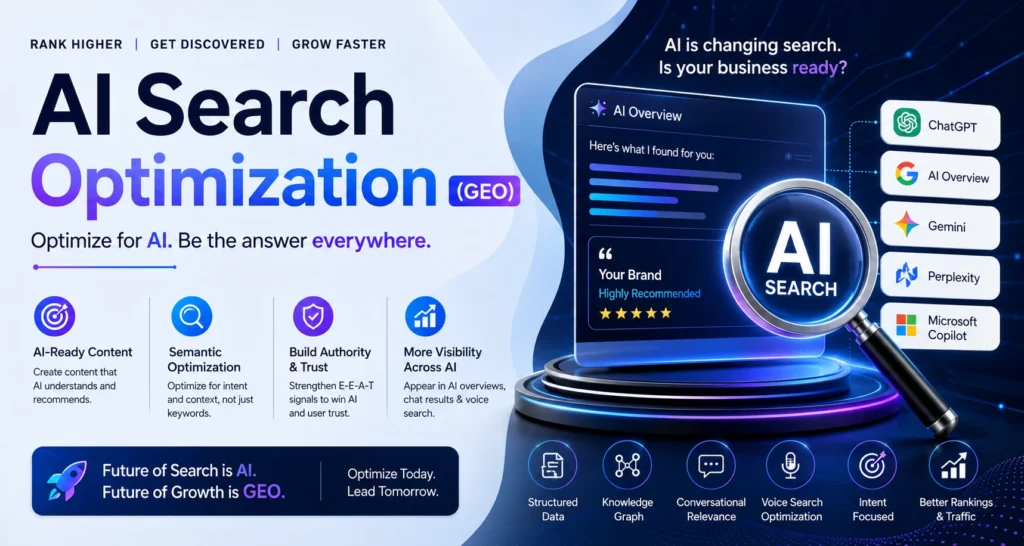
AI Search Optimization (GEO) stands for Generative Engine Optimization. It is the process of optimizing your website and content so that AI-powered search engines can understand, trust, and reference your information when generating answers.
Unlike traditional search engines that mainly display a list of links, AI search engines provide complete responses by combining information from multiple trusted sources.
Examples of AI-powered search platforms include:
- ChatGPT Search
- Google AI Overviews
- Microsoft Copilot
- Perplexity AI
- Gemini
- Claude AI
Instead of competing only for the first position on Google, businesses must now optimize their content to become a trusted source for AI-generated answers.
Why AI Search Optimization (GEO) Matters
Search behavior has changed dramatically over the last few years.
People now search like this:
- Which CRM software is best for small businesses?
- How do I reduce my electricity bill using solar panels?
- What are the benefits of cloud accounting software?
AI tools answer these questions instantly without requiring users to open several websites.
If your content is optimized correctly, AI systems may reference your website while generating these answers.
That means:
- Higher brand visibility
- Increased website authority
- Better qualified traffic
- More leads
- Greater customer trust
Businesses investing in AI Search Optimization (GEO) today are preparing for the future of search.
How Traditional SEO Differs from AI Search Optimization (GEO)
| Traditional SEO | AI Search Optimization (GEO) |
|---|---|
| Focuses on keyword rankings | Focuses on answer relevance |
| Optimizes for search engines | Optimizes for AI systems |
| Targets clicks | Targets citations and visibility |
| Backlinks are primary signals | Trust and authority are equally important |
| Meta tags drive rankings | Context and semantic meaning matter more |
Traditional SEO is still important. However, AI Search Optimization (GEO) builds on SEO by helping AI understand your expertise and content quality.
How AI Search Engines Work
Modern AI search engines do far more than match keywords.
They evaluate:
- User intent
- Topic relationships
- Context
- Website authority
- Content freshness
- Expert credibility
- Structured information
For example, someone searching for “best digital marketing agency” is likely looking for:
- Experience
- Services
- Pricing
- Reviews
- Case studies
- Contact information
Instead of showing only blue links, AI combines this information into one comprehensive response.
Your content must therefore answer questions naturally and comprehensively.
Why Businesses Should Start Using AI Search Optimization (GEO)
Businesses that embrace GEO early gain a significant competitive advantage.
Better Brand Recognition
When AI repeatedly references your business, users begin recognizing your brand as an authority.
Improved Trust
AI systems prefer trustworthy websites that demonstrate expertise and transparency.
Higher Quality Leads
People discovering your business through AI recommendations often have stronger purchase intent.
Long-Term SEO Benefits
Many GEO practices also improve traditional SEO performance.

Key Elements of AI Search Optimization (GEO)
Successful GEO strategies focus on several important components.
1. Helpful Content
Create content that genuinely solves user problems instead of simply targeting keywords.
Good examples include:
- Step-by-step guides
- Tutorials
- Industry insights
- Comparison articles
- Frequently asked questions
2. Topic Authority
Publishing one article is no longer enough.
Instead, build complete content clusters around your niche.
For example, a digital marketing agency might create articles about:
- SEO
- Local SEO
- Technical SEO
- AI Search Optimization (GEO)
- Content Marketing
- Google Business Profile
- Website Performance
- Conversion Rate Optimization
This helps AI understand your expertise.
3. EEAT Signals
Google emphasizes Experience, Expertise, Authoritativeness, and Trustworthiness.
AI systems also value these signals.
Improve EEAT by including:
- Author profiles
- Company information
- Client testimonials
- Case studies
- Contact details
- Updated content
- Reliable sources
4. Structured Content
AI systems process organized content more efficiently.
Use:
- Clear headings
- Short paragraphs
- Bullet points
- Tables
- Numbered lists
- FAQs
This increases the chances of appearing in AI-generated summaries.
Real-World Example
Imagine two websites offering website development services.
Website A
- Thin content
- Keyword stuffing
- No author
- No case studies
- Poor navigation
Website B
- Comprehensive guides
- Expert-written blogs
- Client success stories
- Fast website
- Structured FAQs
- Regular updates
AI platforms are much more likely to reference Website B because it demonstrates credibility and provides greater value to users.
Benefits of AI Search Optimization (GEO)
Businesses implementing AI Search Optimization (GEO) can expect several long-term advantages:
- Increased AI search visibility
- Better organic traffic
- Improved brand authority
- Higher customer trust
- More qualified leads
- Stronger content performance
- Future-ready SEO strategy
- Better user experience
- Increased engagement
- Higher conversion potential
These benefits make GEO an essential addition to any modern digital marketing strategy.
The Future of AI Search Optimization (GEO)
Artificial intelligence is evolving rapidly, and search behavior is changing along with it. Over the next few years, users will increasingly rely on AI assistants instead of typing traditional keyword-based searches into search engines. Businesses that invest in AI Search Optimization (GEO) today will be better prepared for this transformation.
Future AI search experiences will become more personalized, conversational, and context-aware. Rather than displaying a list of websites, AI systems will recommend products, services, businesses, and solutions based on user preferences, location, previous interactions, and intent.
This means businesses must focus on becoming trusted sources of information rather than simply chasing rankings.
Trends Shaping the Future of GEO
Several emerging trends are influencing how AI search works:
- Conversational AI becoming the primary search interface
- Increased use of multimodal search (text, images, voice, and video)
- Better understanding of entities and relationships
- Greater emphasis on first-hand experience and expertise
- Stronger focus on trustworthy and verified information
- AI-generated summaries replacing traditional search snippets
Organizations that consistently publish authoritative content and demonstrate expertise are more likely to be cited in these AI-generated experiences.
Industry-Specific AI Search Optimization (GEO) Strategies
Although the core principles of AI Search Optimization (GEO) remain the same, different industries can benefit from tailored approaches.
Local Businesses
Local businesses should:
- Maintain an updated Google Business Profile
- Display accurate business information
- Collect genuine customer reviews
- Publish local service pages
- Create location-specific blog content
Example
A restaurant can publish guides such as:
- Best Family Restaurants in Chennai
- Healthy South Indian Breakfast Ideas
- Catering Tips for Corporate Events
Such content increases local relevance and authority.
E-commerce Websites
Online stores should optimize:
- Product descriptions
- Buying guides
- Product comparison articles
- Customer reviews
- Frequently asked questions
Providing detailed product information helps AI understand your offerings and improves the likelihood of being referenced.
SaaS Companies
Software businesses should create:
- Feature comparison pages
- Implementation guides
- Customer success stories
- Video tutorials
- Knowledge base articles
This content demonstrates expertise while addressing user intent at different stages of the buying journey.
Healthcare
Healthcare websites should prioritize:
- Expert-reviewed medical content
- Author credentials
- Evidence-based information
- Updated treatment guidelines
- Patient education resources
Trust is especially important in health-related topics.
Educational Institutions
Schools, colleges, and training providers should publish:
- Course guides
- Career advice
- Admission information
- Student success stories
- Industry insights
Educational content naturally attracts long-term organic traffic.
How to Optimize for Featured Snippets
Featured snippets continue to influence AI-generated search responses. Structuring content for quick answers improves the chances of being referenced.
Use Numbered Lists
Example:
Steps to Implement AI Search Optimization (GEO):
- Research user intent.
- Create people-first content.
- Strengthen EEAT signals.
- Use structured headings.
- Add schema markup.
- Build topic clusters.
- Update content regularly.
Answer Questions Clearly
Provide concise answers immediately below each heading before expanding with additional details.
Include Comparison Tables
Comparison tables make information easier for users and AI systems to interpret.
| Traditional SEO | AI Search Optimization (GEO) |
|---|---|
| Focuses on search rankings | Focuses on AI-generated visibility |
| Keyword-centric | Intent and context-centric |
| Click-oriented | Answer-oriented |
| Backlinks are key | Trust, expertise, and relevance are equally important |
Frequently Asked Questions (FAQs)
Conclusion
The future of search is no longer limited to traditional search engine rankings. As AI-powered search experiences continue to grow, businesses must adapt their content strategies to remain visible and competitive.
AI Search Optimization (GEO) is more than a new SEO trend—it is a long-term approach focused on creating valuable, trustworthy, and user-centric content that AI systems can confidently reference. By building topical authority, demonstrating EEAT, improving technical performance, and answering user intent comprehensively, businesses can strengthen both their search visibility and their reputation.
Organizations that begin implementing AI Search Optimization (GEO) today will be better positioned to attract qualified traffic, build customer trust, and succeed in the evolving digital landscape.
Call to Action
If you’re ready to future-proof your online presence with AI Search Optimization (GEO), advanced SEO strategies, high-performing website design, and comprehensive digital marketing solutions, partner with Winkdezign.
Visit winkdezign to discover how expert SEO, content marketing, web development, and AI-driven optimization strategies can help your business increase visibility, generate qualified leads, and achieve sustainable online growth.