


Generative Engine Optimization (GEO): Introduction
Artificial Intelligence is transforming the way people search for information online. Instead of clicking through multiple websites, users are increasingly relying on AI-powered search engines that provide direct answers. This shift has created a new branch of search optimization known as Generative Engine Optimization (GEO).
Businesses that once focused only on traditional SEO now need to optimize their content for AI-generated responses. Whether someone uses ChatGPT, Google AI Overviews, Microsoft Copilot, Gemini, or Perplexity AI, the goal remains the same—provide the most relevant, trustworthy, and well-structured information.
If your website isn’t prepared for AI-powered search, you could lose valuable visibility even if you rank well on Google.
This guide explains everything you need to know about Generative Engine Optimization (GEO), why it matters, and how businesses can prepare for the future of search.
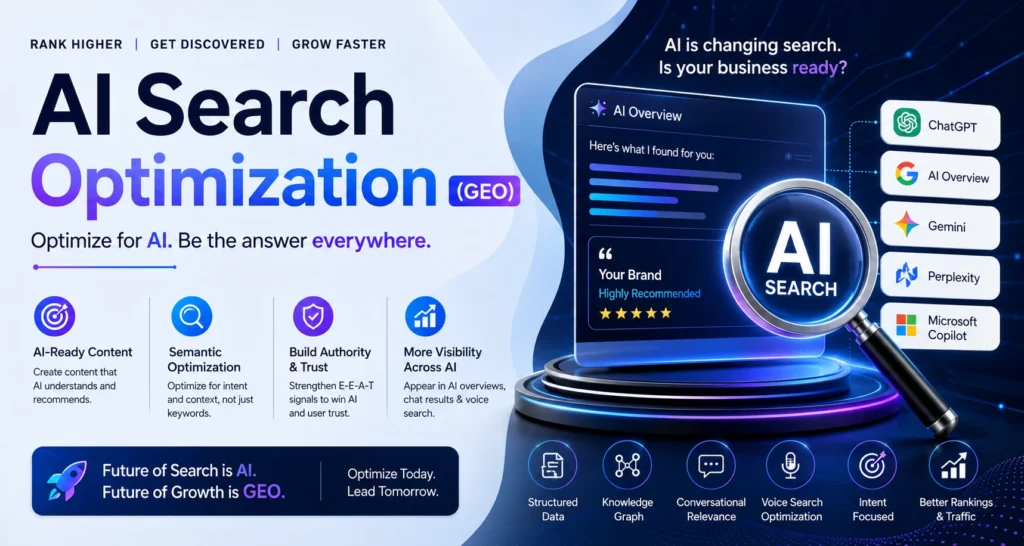
What is Generative Engine Optimization (GEO)?
Generative Engine Optimization (GEO) is the process of optimizing website content so Artificial Intelligence search engines can understand, trust, and reference it while generating answers for users.
Unlike traditional SEO, which focuses on improving rankings in search engine result pages (SERPs), GEO focuses on increasing the chances that AI systems use your content when creating responses.
Simply put:
Traditional SEO = Rank on Google
Generative Engine Optimization (GEO) = Become the source AI trusts and cites.
Why GEO Matters More Than Ever
Search behavior is changing rapidly.
A few years ago, users searched like this:
“Best CRM software”
Today, users ask:
“Which CRM software is best for a small manufacturing company with less than 20 employees?”
Instead of showing ten blue links, AI tools generate a detailed answer by combining information from trusted sources.
If your content becomes one of those trusted sources, your brand gains:
- More visibility
- Better authority
- Higher trust
- Increased website traffic
- More qualified leads
Businesses that adopt Generative Engine Optimization (GEO) today will have a significant advantage as AI-powered search continues to grow.
How Search Has Evolved
| Search Era | Primary Focus | User Experience |
|---|---|---|
| Early Search | Keyword Matching | Basic search results |
| Google SEO Era | Rankings & Backlinks | Competitive SERP rankings |
| Mobile Search | Page Speed & User Experience (UX) | Mobile-first browsing experience |
| Voice Search | Conversational Queries | Natural language interactions |
| AI Search | Context, Intent & Trusted Answers | Direct AI-generated responses |
How AI Search Engines Work
AI search engines don’t simply search for keywords.
They attempt to understand:
- User intent
- Context
- Relationships between topics
- Entity connections
- Authority
- Trustworthiness
- Freshness of information
When someone asks:
“How can a local business improve AI search visibility?”
An AI engine searches multiple trusted sources, evaluates the quality of information, and generates a comprehensive answer.
Instead of showing one webpage, it creates an entirely new response using reliable information.
That’s why content quality matters more than keyword stuffing.
Traditional SEO vs Generative Engine Optimization (GEO)
| Traditional SEO | Generative Engine Optimization (GEO) |
|---|---|
| Focuses on improving search engine rankings | Focuses on increasing visibility in AI-generated answers and citations |
| Keywords are the primary optimization factor | Context, intent, and semantic relevance are the primary focus |
| Backlinks play a major role in rankings | Authority, trustworthiness, and content quality carry more weight |
| The goal is to drive clicks from search results | The goal is to become a trusted source for AI-generated responses |
| Search engines crawl and index web pages | AI models understand concepts, entities, and relationships between topics |
| Optimized for Search Engine Results Pages (SERPs) | Optimized for AI-generated answers, summaries, and conversational search |

What Makes AI Trust Your Content?
AI models don’t randomly choose information.
They prioritize content that demonstrates expertise, clarity, and reliability.
Several factors influence whether AI systems consider your content trustworthy.
1. Clear Structure
Content with proper headings, subheadings, bullet points, and logical flow is easier for AI to interpret.
Example:
Bad:
A long block of text covering multiple ideas.
Better:
- Definition
- Benefits
- Process
- Examples
- FAQs
- Conclusion
Structured content improves both user experience and AI comprehension.
2. Topical Depth
Instead of writing a 500-word article on GEO, create comprehensive content that answers related questions.
For example, an article on Generative Engine Optimization (GEO) should naturally include topics such as:
- AI search engines
- Entity SEO
- Semantic SEO
- AI Overviews
- Knowledge Graphs
- Content authority
- EEAT
- Structured data
This helps AI understand your expertise on the subject.
3. Experience-Based Content
Google’s EEAT guidelines emphasize real-world experience.
Rather than writing generic advice, include practical insights.
Mini Case Scenario
A local digital marketing agency optimized its blog by:
- Adding detailed FAQs
- Including step-by-step guides
- Using structured headings
- Updating outdated information
- Demonstrating real client outcomes
Within a few months, the website began appearing more frequently in AI-generated search responses, leading to increased brand visibility and higher-quality inquiries.
This illustrates how practical, user-focused improvements can enhance GEO performance.
4. Accurate Information
AI systems prefer information that is:
- Factually correct
- Well-organized
- Consistent
- Updated regularly
- Supported by reputable sources
Outdated or misleading content is less likely to be referenced.
Ranking Signals That Matter for GEO
While Google has over 200 ranking signals, AI-powered search systems generally prioritize a combination of quality, context, and trust.
The following factors significantly improve your chances of being referenced.
1. Topical Authority
Publishing a single article about digital marketing isn’t enough.
AI prefers websites that consistently cover an entire subject in depth.
For example:
Instead of publishing only:
- What is Generative Engine Optimization?
Create supporting articles such as:
- AI Search Optimization Guide
- Entity SEO Explained
- Semantic SEO Strategies
- AI Overviews Optimization
- Knowledge Graph Optimization
- LLM Optimization
- Prompt Search Optimization
- AI Citation Building
- AI Crawl Optimization
Together, these articles demonstrate subject expertise and strengthen your site’s topical authority.
2. Semantic Relevance
Traditional SEO often focused heavily on repeating keywords.
Modern AI systems focus on meaning.
For example, an article about Generative Engine Optimization (GEO) should naturally discuss related concepts such as:
- Artificial Intelligence
- AI Search
- Search Intent
- Machine Learning
- Large Language Models
- Natural Language Processing
- Knowledge Graph
- Semantic Search
- Entity SEO
- AI Citations
- Retrieval Systems
- Conversational Search
These related terms help AI understand the full context of your content.
3. Context Over Keywords
AI understands complete questions rather than isolated words.
Consider these two searches:
Search 1:
GEO
Search 2:
How can a small business optimize its website for AI search engines?
The second query provides context.
Your content should answer complete questions, not just target keywords.
4. Information Accuracy
AI systems prioritize factual correctness.
Before referencing your content, they look for signals such as:
- Accurate definitions
- Updated statistics
- Consistent terminology
- Reliable explanations
- Logical structure
Incorrect or outdated information reduces trust.
5. Content Freshness
AI prefers content that reflects the latest developments.
For example, an article discussing AI search written in 2022 may miss:
- Google AI Overviews
- New LLM developments
- Changes in search behavior
- Emerging GEO best practices
Updating existing content is often more effective than continually creating new pages.
Entity SEO and GEO
Entities are becoming one of the most important aspects of AI search.
An entity is a clearly identifiable person, company, place, product, or concept.
Examples include:
- OpenAI
- Microsoft
- ChatGPT
- Gemini
- Artificial Intelligence
- Search Engine Optimization
When your content clearly defines entities and explains their relationships, AI gains a better understanding of your topic.
Example
Instead of writing:
ChatGPT changed search.
Write:
ChatGPT, developed by OpenAI, has transformed how users discover information by providing conversational answers generated from trusted knowledge sources.
This version provides context and strengthens semantic understanding.
Technical Generative Engine Optimization (GEO)
Creating high-quality content is only one part of Generative Engine Optimization (GEO). Your website also needs a strong technical foundation so AI-powered search engines can crawl, understand, and retrieve your content efficiently.
Think of it this way:
Great content tells AI what you know.
Technical GEO tells AI how to find and understand it.
A website with excellent articles but poor technical optimization may struggle to appear in AI-generated responses.
The Future of Generative Engine Optimization (GEO)
Artificial Intelligence is transforming search faster than any previous technological shift. Instead of simply listing webpages, AI-powered search engines now understand user intent, summarize information, and recommend trusted sources.
As AI continues to evolve, Generative Engine Optimization (GEO) will become a core part of every digital marketing strategy.
Businesses that invest in GEO today will be better prepared for tomorrow’s search landscape.
Future AI search will focus on:
- Better understanding of user intent
- Personalized AI-generated answers
- Real-time information retrieval
- Multimodal search (text, voice, image, and video)
- Stronger emphasis on trusted brands and authoritative websites
This means businesses can no longer rely solely on keyword rankings. They must also become reliable sources that AI systems recognize and trust.
Frequently Asked Questions (FAQs)
Conclusion
The future of search is no longer limited to traditional search engine rankings. AI-powered platforms are changing how users discover information, compare solutions, and make decisions. Businesses that want to stay competitive must go beyond keyword optimization and create content that AI systems can understand, trust, and confidently reference.
Generative Engine Optimization (GEO) is not about replacing SEO—it is about expanding your digital strategy for the next generation of search. By combining high-quality content, semantic optimization, structured data, strong technical SEO, topical authority, and Google’s EEAT principles, you can improve your visibility across both traditional search engines and AI-generated search experiences.
Whether you’re a startup, local business, eCommerce brand, or enterprise, investing in GEO today will help you build long-term authority, strengthen your online presence, and reach users wherever they search.
Call to Action
Ready to prepare your website for the future of AI-powered search?
At Winkdezign, we help businesses implement Generative Engine Optimization (GEO), AI Search Optimization, Semantic SEO, Entity SEO, and advanced digital marketing strategies designed for both traditional search engines and AI-driven platforms.
Visit http://winkdezign.com to discover how our GEO and SEO experts can help your business increase visibility, build authority, and stay ahead in the evolving world of AI search.