


Entity SEO: The Complete Guide to Building Search Authority in the AI Era
Search engine optimization has changed dramatically over the past few years. Ranking a webpage is no longer just about using the right keywords or building backlinks. Today, Google focuses on understanding the meaning behind content, the relationships between topics, and the credibility of brands. This is where Entity SEO becomes one of the most important strategies for businesses, marketers, and website owners.
Instead of treating words as isolated keywords, search engines now identify people, places, businesses, products, and concepts as entities. They connect these entities using structured data, contextual information, and trusted sources to provide users with more accurate search results.
If you want your website to stay competitive in Google’s AI-powered search environment, learning Entity SEO is essential. Whether you own a local business, an eCommerce store, or a digital marketing agency, entity-based optimization helps improve visibility, authority, and long-term rankings.
In this comprehensive guide, you’ll learn what Entity SEO is, why it matters, how Google understands entities, and the practical steps you can take to optimize your website for modern search engines.
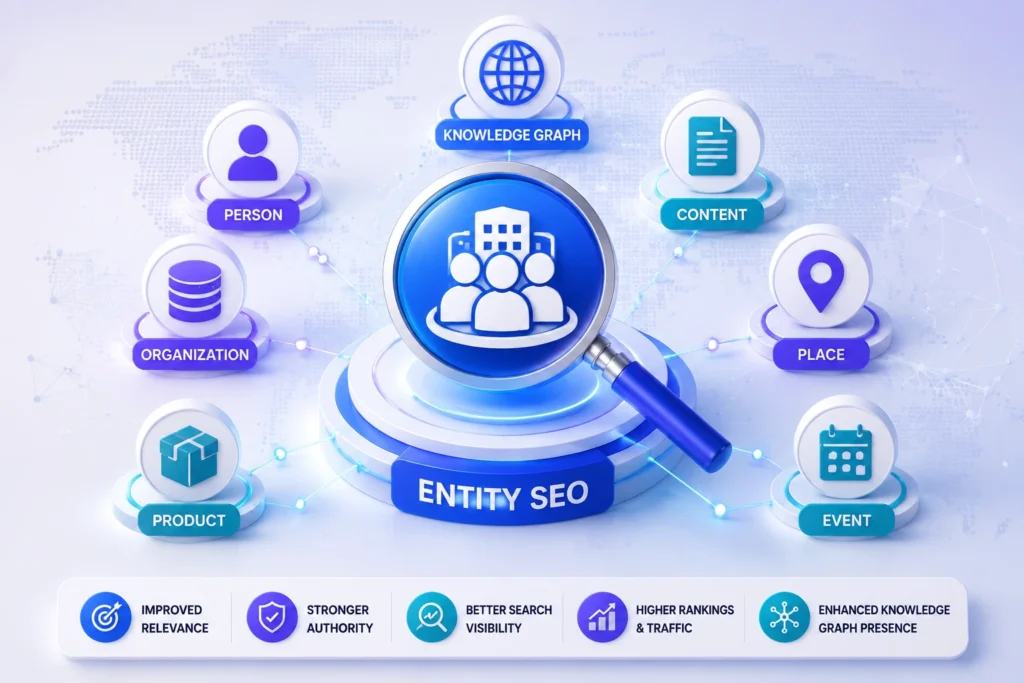
What is Entity SEO?
Entity SEO is the process of optimizing your website around identifiable entities instead of relying only on keywords.
An entity can be almost anything that has a unique identity. This includes:
- A person
- A company
- A product
- A location
- An organization
- An event
- A service
- A concept
Unlike keywords, entities have context and relationships.
For example:
Keyword: Apple
This keyword could mean:
- Apple fruit
- Apple Inc.
- Apple Store
- Apple pie
Google uses entities to understand which meaning is correct based on surrounding content.
That ability helps Google deliver much more relevant search results.
Why Entity SEO Matters More Than Traditional SEO
Traditional SEO focused mainly on:
- Keyword density
- Meta tags
- Backlinks
- Exact-match anchor text
While these factors still matter, Google’s AI systems now evaluate content differently.
Modern search algorithms try to understand:
- Who created the content?
- Is the business trustworthy?
- What topics does the website consistently cover?
- How are different concepts related?
- Is this brand recognized across the web?
Entity SEO answers all these questions.
As Google becomes smarter, websites built around clear entities gain a significant ranking advantage.
How Google Understands Entities
Google doesn’t simply read text.
Instead, it builds relationships between millions of entities using advanced technologies like:
- Natural Language Processing (NLP)
- Knowledge Graph
- Machine Learning
- Structured Data
- Semantic Search
When Google crawls a webpage, it identifies important entities and connects them with other trusted information already stored in its knowledge base.
For example, imagine a page about digital marketing.
Google may recognize entities such as:
- SEO
- Content Marketing
- Google Ads
- AI Search
- Local SEO
- Analytics
- Website Design
Instead of viewing these as random keywords, Google understands how they relate to one another.
This improves search accuracy significantly.
Understanding Google's Knowledge Graph
One of the biggest reasons Entity SEO works is Google’s Knowledge Graph.
The Knowledge Graph is a massive database containing billions of connected entities and their relationships.
For example:
Business
↓
Founder
↓
Products
↓
Location
↓
Industry
↓
Customers
↓
Reviews
↓
Website
Google uses these relationships to understand brands better.
If your business information appears consistently across trusted websites, Google gains more confidence in your entity.
That confidence often translates into stronger rankings.
Keywords vs Entity SEO
| Traditional SEO | Entity SEO |
|---|---|
| Focuses on keywords | Focuses on meaning |
| Exact keyword usage | Contextual understanding |
| Search intent | Entity relationships |
| Backlinks | Authority + Context |
| Page optimization | Topic optimization |
| Individual pages | Entire brand ecosystem |
Entity SEO doesn’t replace keyword optimization.
Instead, it builds on traditional SEO by adding context and authority.

What Counts as an Entity?
Many website owners think entities only refer to famous brands.
That’s not true.
Entities include almost everything Google can identify uniquely.
Examples include:
People
- Business owners
- Doctors
- Authors
- CEOs
- Consultants
Organizations
- Companies
- Universities
- Government agencies
- NGOs
Products
- Smartphones
- Software
- Cars
- Digital tools
Locations
- Cities
- States
- Tourist destinations
- Restaurants
Services
- SEO Services
- Web Design
- PPC Management
- Content Writing
Events
- Conferences
- Product launches
- Festivals
- Sports tournaments
How Entity SEO Improves Rankings
Entity optimization helps Google answer three major questions.
1. Who are you?
Google wants to know:
- Is this a real business?
- Is the author genuine?
- Is the company established?
Clear entity signals build trust.
2. What do you specialize in?
Imagine two websites.
Website A publishes random topics every week.
Website B consistently publishes content about SEO, AI marketing, local SEO, technical SEO, and website optimization.
Google quickly understands Website B as an SEO authority.
Entity SEO strengthens topical authority.
3. Can users trust your information?
Google cross-checks information using:
- Business profiles
- Social media
- Citations
- Industry websites
- Reviews
- Structured data
The more consistent these signals are, the stronger your entity becomes.
Entity SEO and Google's EEAT Guidelines
Google emphasizes Experience, Expertise, Authoritativeness, and Trustworthiness (EEAT) when evaluating content quality.
Entity SEO supports every part of EEAT by making your business, authors, and expertise easier for search engines to recognize and verify.
Experience
Show real-world involvement through:
- Original case studies
- Project screenshots
- Client success stories
- Personal insights
- Practical examples
Expertise
Publish detailed content that demonstrates deep knowledge of your niche.
For example, if your business offers SEO services, create comprehensive guides on technical SEO, local SEO, content strategy, structured data, and Entity SEO instead of covering unrelated topics.
Authority
Authority grows when trusted websites mention your business and when your content consistently answers users’ questions better than competitors.
Building quality backlinks, earning citations, and maintaining accurate business profiles all contribute to stronger authority.
Trust
Trust comes from transparency.
Include:
- Contact details
- Author information
- Privacy Policy
- Terms and Conditions
- Customer testimonials
- Secure HTTPS website
- Accurate business information across all platforms
These trust signals reinforce your entity and improve credibility with both users and search engines.
Entity SEO Strategies That Actually Work
Building a strong entity isn’t about adding one schema markup or repeating your brand name across every page. It requires a complete SEO strategy that consistently reinforces your expertise, authority, and relevance.
Here are the most effective Entity SEO strategies you can implement today.
Build Topical Authority Instead of Publishing Random Content
One of Google’s biggest ranking factors today is topical authority.
Rather than writing about dozens of unrelated subjects, focus on becoming an expert within your niche.
For example, if your website offers SEO services, your content should cover topics like:
- Entity SEO
- Technical SEO
- Local SEO
- On-Page SEO
- Off-Page SEO
- AI SEO
- Semantic SEO
- Google Search Console
- Core Web Vitals
- Structured Data
When Google sees multiple high-quality articles around related entities, it begins to recognize your website as an authority in that subject area.
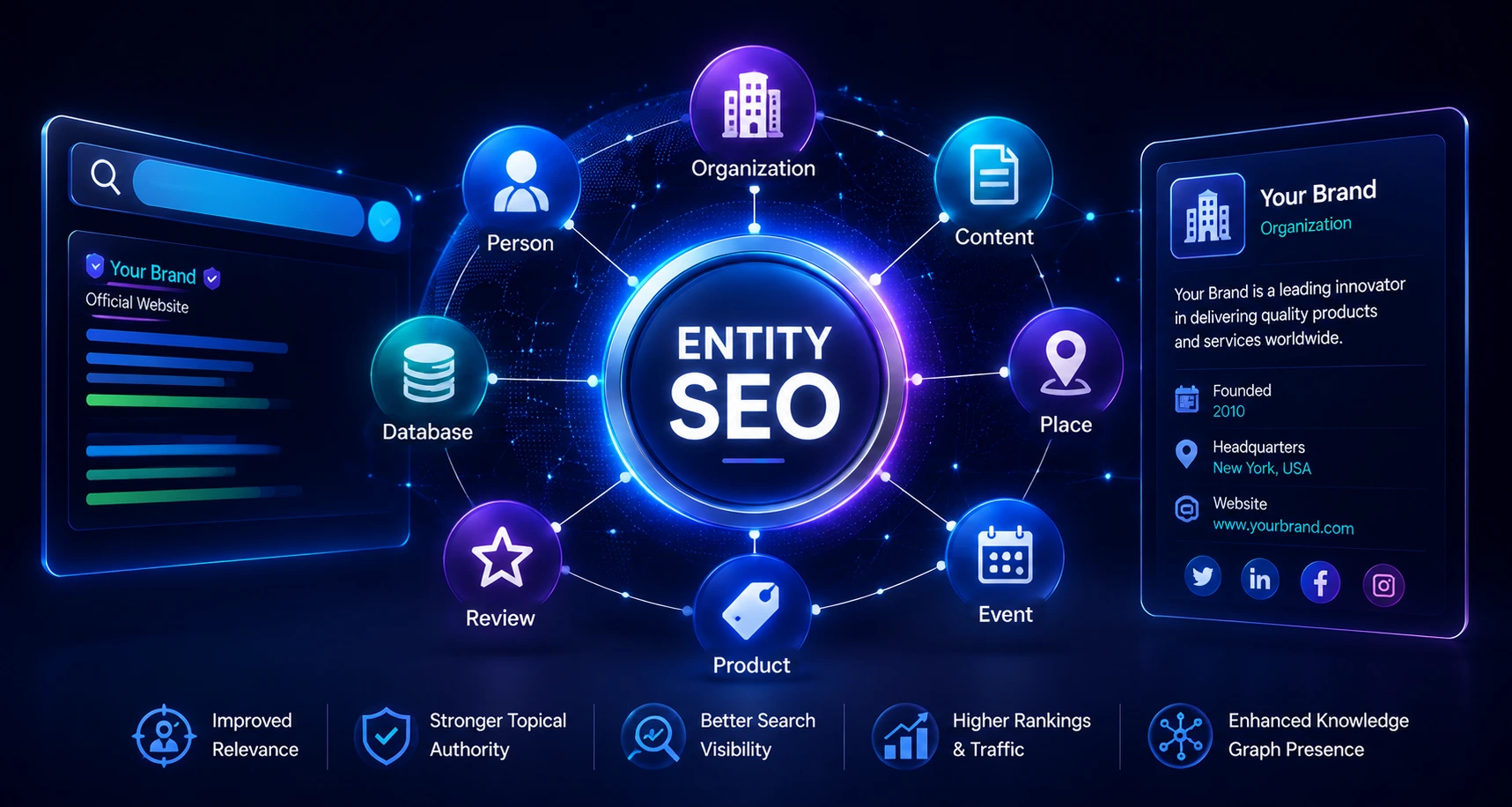
Optimize Every Important Entity on Your Website
Each page should clearly define its primary entity.
Examples include:
Homepage
Primary Entity:
Your Business
About Page
Primary Entity:
Founder or Organization
Service Pages
Primary Entity:
Specific Service
Example:
- SEO Services
- Website Design
- Digital Marketing
- Ecommerce Development
Blog Articles
Primary Entity:
Educational Topic
Avoid mixing too many unrelated entities on a single page.
Measuring the Success of Your Entity SEO Strategy
Like any SEO initiative, Entity SEO should be measured using meaningful performance indicators. Monitoring the right metrics helps you understand whether your optimization efforts are strengthening your online authority.
Key Metrics to Track
| Metric | Why It Matters |
|---|---|
| Organic Traffic | Measures growth from search engines |
| Keyword Rankings | Tracks visibility for target keywords |
| Branded Searches | Indicates increasing brand recognition |
| Click-Through Rate (CTR) | Shows how compelling your search listings are |
| Indexed Pages | Confirms Google is discovering your content |
| Referring Domains | Reflects authority gained through backlinks |
| Engagement Metrics | Time on page, bounce rate, and user interaction |
| Rich Results | Indicates successful schema implementation |
Review these metrics monthly and compare them against previous performance to identify trends and opportunities.
Frequently Asked Questions (FAQs)
- High-quality content
- Topical authority
- Structured data
- Internal linking
- Quality backlinks
- Brand mentions
- Author expertise
- Consistent business information
- Positive user experience
Conclusion
The future of search is centered on understanding, not just matching keywords. As Google’s algorithms become more sophisticated, Entity SEO has become a critical component of sustainable search engine optimization.
By building clear entity relationships, publishing high-quality content, implementing structured data, strengthening topical authority, and maintaining consistent business information, you can create a website that both users and search engines trust.
Remember that Entity SEO is not a replacement for traditional SEO—it enhances it. Combining technical SEO, content optimization, user experience, and entity-based strategies provides a stronger foundation for long-term organic growth.
Whether you’re a local business, an eCommerce brand, or a digital marketing agency, investing in Entity SEO today will help you stay competitive in the evolving landscape of AI-powered search.
Ready to Improve Your Entity SEO?
If you’re looking to build a stronger online presence, improve search visibility, and establish lasting authority, the team at Winkdezign can help.
From technical SEO and content strategy to structured data implementation and website optimization, Winkdezign offers comprehensive digital marketing solutions tailored to your business goals.
👉 Visit http://winkdezign.com to explore SEO services, web design solutions, and digital marketing strategies that drive measurable growth.